Compare Warwick homeowners insurance deductibles. Convert a Rhode Island hurricane deductible to dollars and check what you could owe after the storm.
A 2% hurricane deductible can mean $7,000 out of pocket on a Warwick home insured for $350,000 under Coverage A. The percentage can look small next to a $1,500 standard deductible on the same homeowners insurance quote. Ask for both figures in dollars and ask the insurer when each applies before you compare annual premiums (Rhode Island property insurance and weather claims regulation).
Read the declarations page and hurricane notice
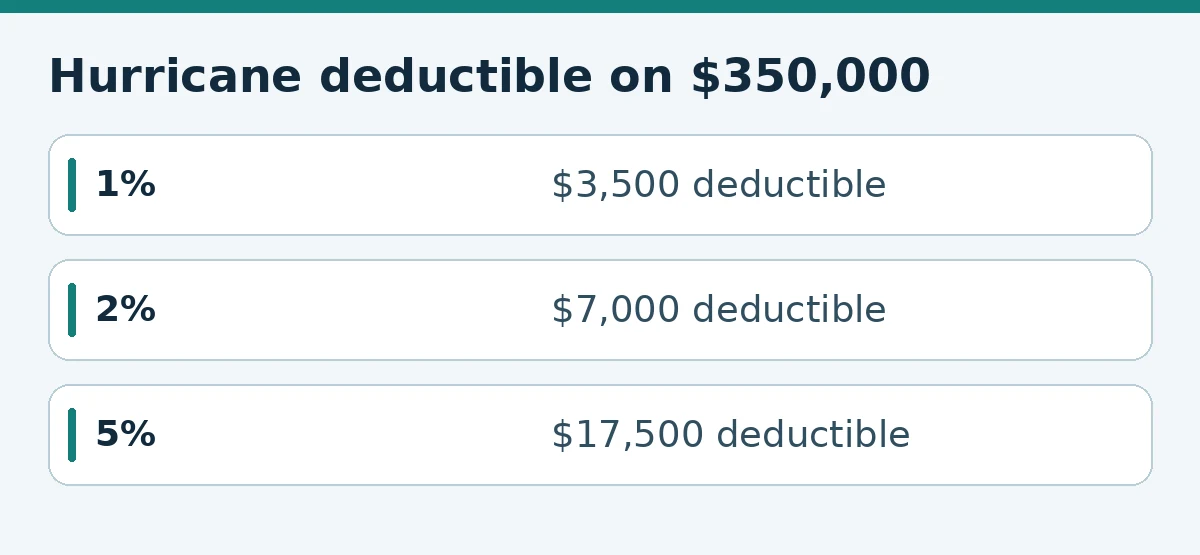
Start with the dwelling limit, labeled Coverage A. In a quote with a hurricane deductible expressed as a percentage of that limit, multiply Coverage A by the percentage. For a $350,000 dwelling limit, 1% is $3,500, 2% is $7,000, and 5% is $17,500. Rhode Island’s regulation caps the hurricane deductible at 5% of the insured dwelling value and requires the dollar amount of an applicable percentage deductible to appear on the declarations page.
Look for the separate standard property deductible and the notice explaining the hurricane trigger. Rhode Island’s rule for residential policies on dwelling houses prohibits a separate windstorm deductible. It permits a hurricane deductible with a defined trigger. For Warwick, that trigger involves a National Weather Service hurricane warning and reported hurricane-force sustained winds in Rhode Island outside Block Island. The regulatory window ends 24 hours after the last hurricane warning for any part of the state ends. Ask the insurer to explain its policy wording and how it would classify a particular loss.
Recalculate the hurricane deductible after a dwelling limit change
For each homeowners quote, calculate the hurricane deductible in dollars using its own dwelling limit. Suppose one quote uses a 2% deductible on $400,000 and another uses 2% on $450,000. The hypothetical deductibles are $8,000 and $9,000. Check the trigger on both forms and use the Warwick rebuilding estimate guide to review why the dwelling amounts differ.
Compare the cost you could carry after a storm
Suppose two quotes have the same $350,000 dwelling limit. One shows a 2% hurricane deductible and the other shows 1%. The first would leave you with $3,500 more of a qualifying covered loss if the full hurricane deductible applies. If it saves $180 per year, compare the immediate $3,500 exposure with the annual savings. You may have to pay for temporary repairs before a claim is settled, so check how much cash you could access on short notice.
Ask each company for written answers to these questions:
- What is the standard deductible and what is the hurricane deductible in dollars?
- If the dwelling limit rises next renewal, what happens to the dollar amount of a percentage deductible?
- Does the insurer offer a flat-dollar hurricane option or a waiver for qualifying mitigation?
- Does the quote include separate coverage for water backup? What exclusions and limits apply?
Compare the payout on the same repair estimate
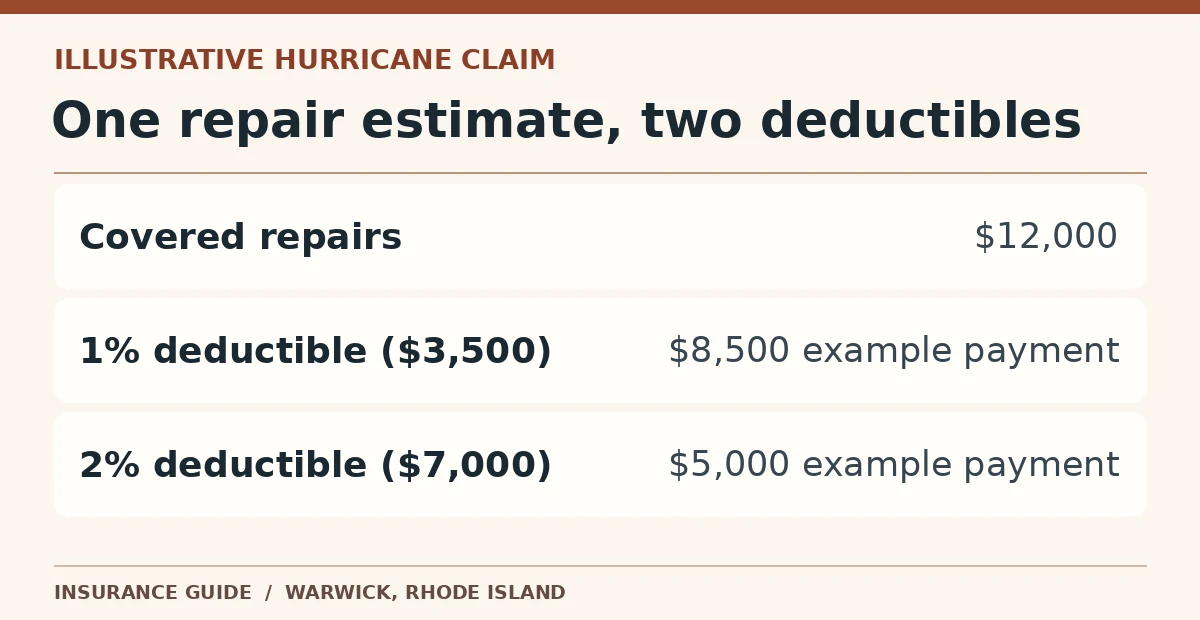
Suppose a roofer estimates $12,000 to repair covered hurricane damage. With a $350,000 dwelling limit and a 1% hurricane deductible, subtract $3,500 to get a simplified payment of $8,500. With a 2% hurricane deductible, subtract $7,000 to get $5,000. The example assumes the same covered scope of work, the same valuation method, and the full deductible applying in both cases. Use an estimate like this when comparing Warwick homeowners insurance quotes. It shows what the difference in deductibles could mean in a claim as well as what it costs at renewal.
Ask about roof settlement before using that calculation on a real quote. One policy may value covered roof damage at replacement cost, while another may use actual cash value or apply an endorsement tied to the age or type of the roof. A $12,000 contractor estimate and a $12,000 covered loss can be different figures. Ask the insurer which amount the deductible would be applied to and how depreciation, if applicable, would affect the initial and final payments (NAIC explanation of actual cash value and replacement cost).
Track the deductible if two hurricanes affect the same home
Rhode Island’s rule generally limits the policy’s hurricane deductible to one application across hurricane occurrences in a calendar year. If the covered loss from the first hurricane is smaller than the deductible, the rule allows the insurer to apply the remaining portion of that deductible or the all-perils deductible to a later loss. The insurer can ask for records of the first loss to determine the amount. If you switched policies during the year, keep any earlier estimates, claim statements, and insurer correspondence. The rule addresses earlier losses even when the same policy was not in force all year (Rhode Island property insurance and weather claims regulation).
When comparing renewal options, calculate the deductible again if the dwelling limit has changed. A move from $350,000 to $390,000 in Coverage A would raise a 2% deductible from $7,000 to $7,800. Put the new dollar amount beside your emergency savings and ask what premium credit the quote reflects for the deductible. If your house has storm shutters or another protective feature, ask which approved mitigation measures qualify for a waiver in your building code zone and what proof the insurer requires. Get the answer before budgeting for installation or counting on a lower amount.
For an actual storm claim, note when you first observed each part of the damage and keep any safely taken photographs or repair records. Ask the adjuster to identify the deductible and explain the trigger it used. If there were two storms, ask for a written accounting showing how the earlier loss affected the calculation.
Check wind and flood as separate risks
Roof or siding damage from wind and water entering from an overflowing waterway can raise different coverage questions. Standard homeowners insurance typically excludes flooding. A hurricane deductible applies only if the loss is otherwise covered and the trigger is met. If rising water is a concern for your property, read the Warwick flood insurance guide and compare that coverage separately (FEMA flood insurance basics).
If you already have an Allstate home quote, review the site’s overview of Allstate home insurance in Warwick alongside the declarations and endorsements the insurer supplied. When choosing between policies, write down each premium, the two deductible amounts, and how much you could pay after a covered loss. That makes the decision easier to revisit when your policy renews. If you’re buying the property, review the full homeowners insurance checklist for closing before sending proof to the lender.
Compare the two deductible amounts on each home insurance quote
Write down the standard deductible, the hurricane percentage, and its equivalent in dollars on the quoted Coverage A. Ask which trigger applies and check the roof valuation method separately. If a carrier increases Coverage A at renewal, use the Warwick dwelling replacement cost guide to verify the estimate and recalculate the percentage deductible.