Review car insurance after paying off your auto loan. Remove the lienholder, check for a GAP refund, and compare collision and comprehensive premiums.
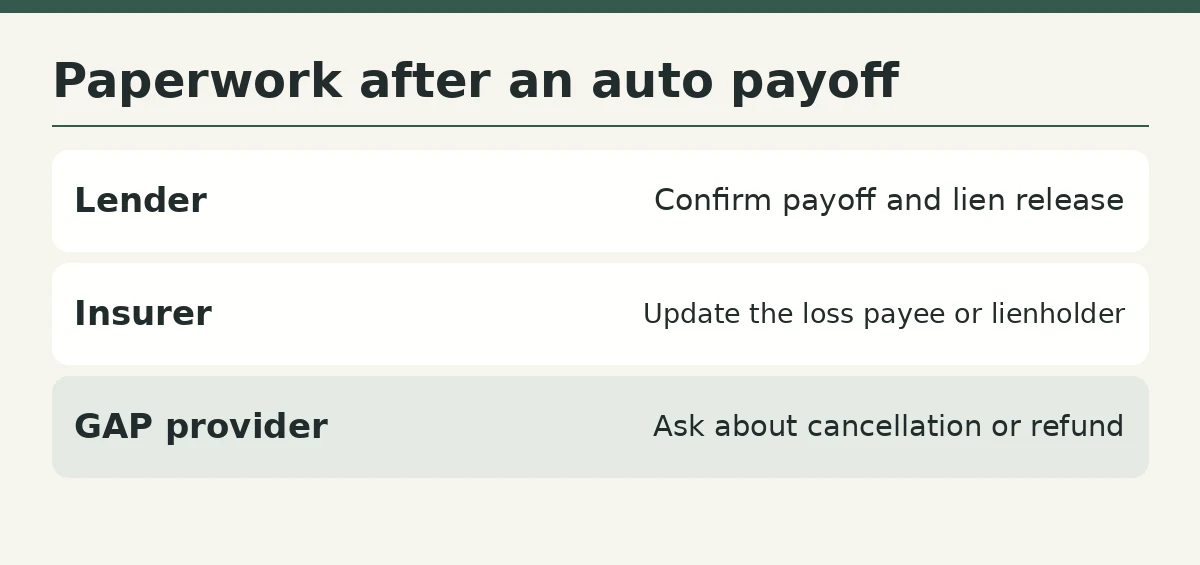
Paying off the car does not change your policy automatically. Get the lender’s payoff confirmation and lien release, then ask the insurer for an updated declarations page. Compare physical damage options for the value and use of the paid-off car. If you financed GAP or another add-on, check the separate agreement for any cancellation or refund conditions.
How to remove the lienholder from your car insurance
Ask the lender for written confirmation the account is paid and find out how it releases the lien. Keep the notice, account reference, and any title instructions. Ask the insurer what proof it wants to remove the lender from the policy. Review the revised declarations for the correct VIN and date. A title update and a change to the insurance contract are separate records, and either can be handled on a different timeline. If you have an open claim, ask the insurer whether its payment instructions depend on the lien record.
If you plan to keep the car, confirm that the insurer applied only the changes you requested. Removing a lender need not remove collision, comprehensive, or any other coverage. Tell the insurer which protections and deductibles to retain. The Rhode Island declarations page guide shows where each line and lender record appears.
Compare paid-off car insurance costs using the next full term
Ask for one quote keeping both physical damage coverages and a second showing the change you are considering. Request the full-term total and the prorated effect of changing during the current term. Check the vehicle’s value and the funds you could use for another car. Read the Warwick collision and comprehensive guide to compare which risks would remain insured.
Should you keep collision insurance on a paid-off car?
Suppose your car is worth about $9,000 and the collision deductible is $750. A covered total loss valued at that amount would leave an illustrative $8,250 before other adjustments. The cost of replacing the car may differ from that amount. Estimate how you would buy another suitable vehicle or pay for temporary transportation. Ask the carrier to price collision alone and record what premium it adds. Consider what happens if the car is still needed for work.
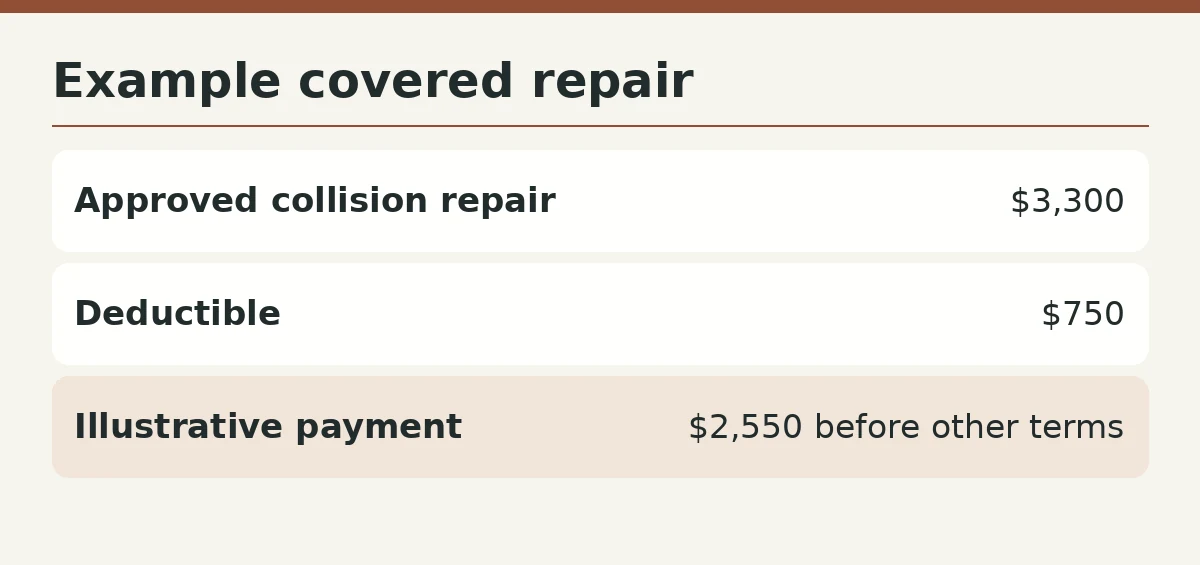
If the quote shows $280 per year for collision, you can compare that premium with the possible loss you would need to absorb. A policy also can help with a qualifying repair below a total loss. On a $3,300 approved repair and a $750 deductible, a simple example leaves $2,550 before other terms. A decision about collision should take account of repair risk as well as the value at the time a car is totaled. The collision and comprehensive guide expands on how each responds.
Compare comprehensive coverage and higher deductible quotes
A car parked outdoors can still face theft, vandalism, falling objects, hail, or other losses that may be covered by comprehensive. Ask what its deductible is and whether the quote has special glass terms. If you remove collision, ask whether comprehensive is available on its own and how removal affects your uninsured motorist property damage selection. Keep the same liability and UM choices across quotes unless you deliberately want to change them.
If you keep collision but increase the deductible, get the premium difference for the same term. An extra $500 out of pocket on a qualifying loss may or may not be worth a small annual saving. Write down the available deductible amounts and estimate what you can pay without delaying repairs. If you have more than one car, price the change per vehicle. Keep the insurer’s written explanation of any difference between a policy change and an endorsement with its own effective date.
Check for a GAP insurance refund after paying off the loan
If you bought GAP through a dealer, lender, or insurer, locate the actual contract. Ask whether it ends with payoff and whether a cancellation or refund can apply. Check how the provider calculates any refund and who receives it. Providers and contract types can handle early payoff differently. Save the request and verify that any promised credit or check arrives. A zero loan balance addresses the risk the GAP product was meant to help with, while the cancellation and refund terms still depend on the contract.
If the payoff happened because you refinanced, confirm the terms of the new loan before changing the auto policy. A new lender can still require collision and comprehensive, and the prior GAP product may not carry over. Compare the financed vehicle insurance guide with the new agreement. If you sold or traded the car, confirm the date you no longer have it before removing the vehicle from your insurance.
Check the bill after the change
Ask when the chosen coverage changes began and what difference applies for the rest of the term. A prorated charge or refund can differ from the annual savings. Check the updated premium and all deductible amounts on the issued document. Retain the prior policy if a loss happened before the change. Keep the lien release and GAP correspondence together so you can identify which company still owes a response.
At renewal, compare what the car is worth with the real cost of losing it. A payoff can change your options immediately, while a move, new commute, or a second car can change the practical decision later. Ask the carrier to quote the same coverages on the new facts and compare the result with the policy you actually carry.
A side-by-side comparison for a paid-off daily driver
A Warwick commuter owns a car valued at roughly $9,000. The insurer offers $1,070 a year with collision and comprehensive, $790 with comprehensive but no collision, or $710 without either. Ask which liability, uninsured motorist and rental options are included in each figure. If there is a lower quote that omits collision, check whether any other selection changed as well. The $280 collision difference is useful only when the rest of the offer is held constant. The $80 comprehensive difference should be evaluated against the causes of loss the household wants to insure.
With the $750 collision deductible from the earlier example, a covered $3,300 repair could leave up to $2,550 payable in a simple calculation. If the household drops collision, it needs to decide how it would handle such a repair. For comprehensive, model a different example such as covered theft or damage by a falling object and use the deductible that actually applies. Write down the potential amounts you retain and decide which risks fit your cash reserves and need for transportation.
Check that payoff and refinancing are not being confused
A zero balance on the original loan may reflect a refinance rather than debt-free ownership. If a new lender paid the old account, ask when the new lender must be listed and what coverage it requires. Check the original lender’s release, any transfer of title information, and the new lender’s proof instructions. Verify the date the insurer updated the policy. Keep both loan references so a late notice from the first company is easy to identify.
If you paid off the loan out of pocket, request the release process from the lender and check the insurer’s record separately. A final automated payment can post before the payoff was fully processed; ask what amount the lender recognizes. After the lien is removed, examine the actual coverage rows before assuming the revision reduced the premium or kept everything the same. If there is an active claim, ask who will receive payments under the paperwork in force for that loss.
Track a GAP or service-contract refund as its own issue
Ask for the specific agreement and cancellation contact. If the provider says a refund is available, request its method and expected payment date. Check where the refund goes if the contract was financed. If you receive a credit, compare it with the paperwork and the lender’s closing statement. Record confirmed amounts separately from an estimate offered when you bought the car. For questions about what a shortfall looked like before payoff, see the Rhode Island total loss valuation guide.
Use the payoff to review coverage on all vehicles, especially if several share the policy. Ask what the premium would be for the remainder of the term and what the full-term estimate would be next time. Save both figures. If you keep a deductible by choice, tell the insurer and retain the confirmation rather than assuming it was tied to the former lender.
Review a smaller comprehensive claim before dropping it
Suppose hail produces an approved $1,750 repair and the comprehensive deductible is $500. The simple illustration leaves $1,250 after that deductible. If you would drop comprehensive to save $80 in annual premium, weigh the saving against the costs you would pay after the risk you still want covered. If you park in a garage most days but travel for long periods, explain where the vehicle is usually kept and whether location changes the quote. Ask about a separate glass provision if a windshield repair is a priority.
A decision to keep some physical damage protection can look different on each car. A household might carry a high deductible on a weekend car and a lower one on its only reliable commuter. Ask the insurer to price the options with the same liability and uninsured motorist selections. Confirm whether a rental or roadside option changes when collision is removed. The Rhode Island rental reimbursement guide explains which transportation limits to look up.
Review a total loss before or after the payoff date
If the car was damaged before the loan was closed, the policy and lienholder information for that date may still matter. Ask the insurer and lender how they coordinate settlement, who will be named on a payment, and what it takes to show payoff. Store the documents from both sides of the change. A new lender release and an earlier claim may have separate records even when both involve the same VIN.
If the loss happened after the release and an old lender still appears on the declaration, ask the insurer to confirm how it will correct the record. Give it evidence that the account closed rather than assuming removing a lienholder is just a billing action. Ask whether the update changes anything about payment or evidence required. Keep the written response with the payout paperwork.
Questions to settle before requesting a coverage change
Does payoff change Rhode Island’s liability requirements? Check what liability coverage still applies to the registered vehicle. A former lender’s condition for collision or comprehensive is separate from state liability requirements. Ask the carrier to identify precisely which part you can change and what proof will remain.
Can I keep the same deductible even if the loan is gone? Ask the insurer to keep it if that fits your budget. The removal of a lien should be documented separately from changing protection. If the insurer sends a revised price, verify the stated deductible immediately.
Will a GAP refund be automatic? Check the provider’s actual terms, who issues refunds, and whether you need to send the payoff proof. Keep the confirmation and check the account or payment. A zero loan balance is useful evidence, while the provider’s record shows what it processed.
Keep a budget for repairs you choose to absorb
If you move to a higher deductible, decide how much you can set aside and how quickly you would need to repair or replace the car. Budget for transportation during the repair as well. A quote that saves $50 this year may change a future decision if the car becomes your only way to get to work. Review the balance when the car’s value changes or another driver starts using it.
Ask for three car insurance quotes after payoff
Keep your current coverage as the baseline. Ask for each vehicle’s collision and comprehensive premiums and deductibles. Confirm the end of any lender requirement before changing physical damage coverage.
Price comprehensive without collision. Ask what that change does to uninsured motorist property damage, rental reimbursement, or other terms. Compare quotes with the same liability coverage and payment term.
Estimate your share of a repair or replacement. Use the car’s plausible current value and your available cash, not the original purchase price. Ask how much the selected option saves over a full term and what share of a covered claim you would retain.
A midterm change can produce a small prorated credit. Ask for separate totals for the remaining term and a full upcoming term. The Warwick premium comparison worksheet explains how to compare amounts when billing periods and fees differ.
Sources consulted
Consumer Financial Protection Bureau, auto financing and GAP guidance; National Association of Insurance Commissioners, Consumer Auto.