Compare personal umbrella insurance quotes in Rhode Island. Check primary liability limits, covered drivers and properties, and the total annual cost.
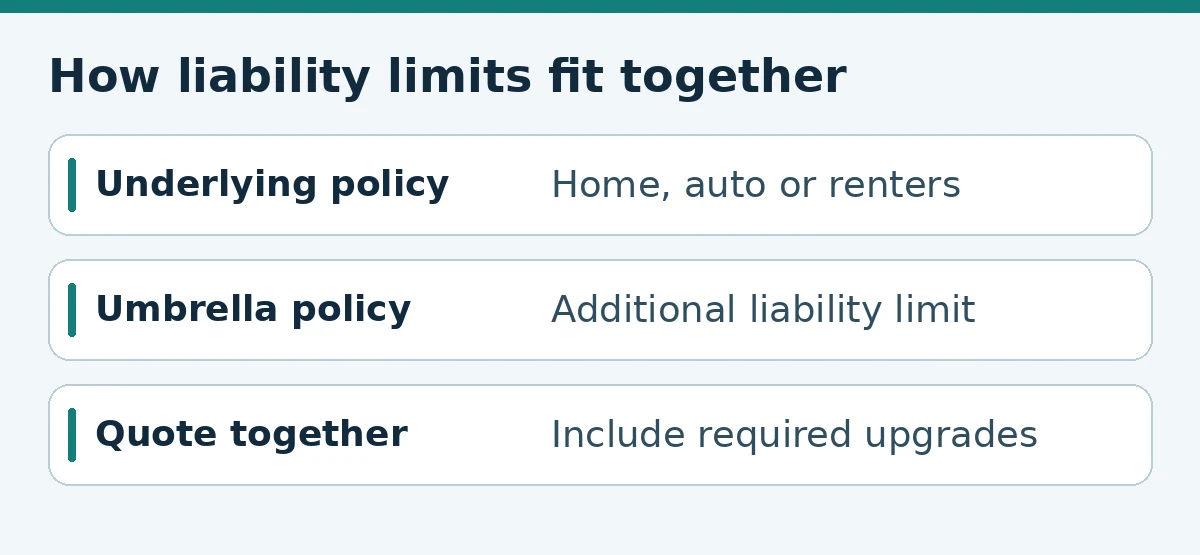
When shopping for personal umbrella insurance in Rhode Island, ask what auto, homeowners, or renters liability limits you must carry underneath it. An umbrella policy can provide an additional layer of liability coverage for certain claims. Your household cost may include both the umbrella premium and an increase in the premium for a primary policy that needs higher limits (NAIC guide to personal umbrella insurance).
See how an umbrella policy can respond
Assume a covered auto accident leads to $550,000 in liability damages, your primary policy pays its $300,000 applicable limit, and a $1 million umbrella covers the same claim. In that simplified example, $250,000 would sit above the primary limit. Whether the umbrella pays that amount depends on its own coverage, exclusions, and requirements. Ask how the insurer handles defense costs and whether those costs can reduce the available limit.
Start with your declarations pages. List the vehicles and drivers in your household and any other exposures you want the umbrella to cover, such as a boat or rental property. Ask the insurer to confirm which people, properties, and vehicles it includes. If you use a car for business, rideshare, or delivery, disclose it when you ask for quotes and get a written answer about coverage.
Include your rental address on the personal umbrella quote
If you own a rental, give the broker its address, occupancy, and primary landlord liability limits. Ask whether it can be scheduled and whether the required underlying amount differs from the house you occupy. Price any underlying increase along with the umbrella premium. Use the Warwick landlord insurance quote guide to confirm the primary policy’s protection before adding the second layer.
Compare the umbrella and underlying premiums together
Suppose Company A quotes $290 per year for an umbrella and requires an auto liability upgrade that adds $130. Company B quotes $370 and accepts the limits you already carry. The added annual costs are $420 and $370, respectively, before fees or other changes. The $420 combination includes higher underlying auto limits. Ask Company B to price the same limits so you can compare the policies on equal terms. Use the Warwick car insurance quote checklist to price the same underlying limits with each carrier.
For each quote, record:
- The umbrella limit and the minimum underlying liability limits for each policy.
- Any requirements about using the same insurer for home, auto, and umbrella coverage.
- The exclusions that affect your household, including any listed business or rental property limitations.
- The total added premium, with changes to the underlying policies included.
Check the umbrella’s required limits against each declarations page
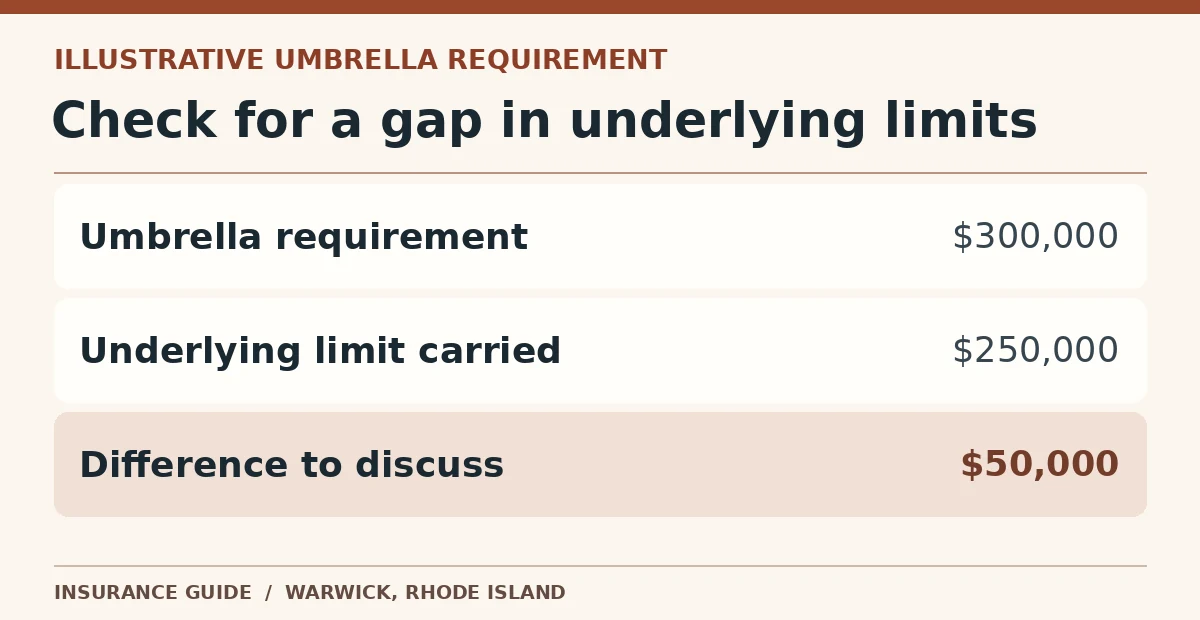
Suppose an umbrella requires $300,000 in underlying auto liability for a particular exposure, but the declarations page for one household vehicle shows $250,000 on the relevant limit. There is a $50,000 difference between the two figures. Ask the umbrella insurer whether its policy would treat the missing amount as your responsibility, whether it applies another rule, and how to bring the policy into compliance. Use the same liability limit for the comparison. A per-person limit and a per-accident limit can describe different parts of a split-limit policy.
Repeat that check for your home or rental unit and for any boat or additional property that you expect the umbrella to cover. Ask whether each exposure must be listed and insured under an underlying policy. Review exclusions and any schedules or endorsements on the actual umbrella quote. A household may have the right limit on its primary insurance and still need to check whether an activity falls within the umbrella’s terms (NAIC overview of umbrella liability insurance).
Compare what is covered for the people in your household
Ask the insurer to show you the policy’s definition of an insured person. Read it alongside the names and addresses on your primary policies. If an adult child returns home or a family member keeps a household vehicle at a second address, describe that arrangement and ask whether it changes who is covered. If your cars are insured on separate policies, ask which limits the umbrella requires on each vehicle. Verify that the response matches the policy or endorsement you receive.
Describe any work or income-producing activity that could affect liability coverage, including paid use of a car or short-term rental use of a property. Ask whether a personal umbrella applies to that specific activity, whether an endorsement is available, and whether a separate commercial policy would be needed. Record the answer alongside the quote so you can compare the treatment of the same activity across carriers.
Walk through one liability scenario with each insurer. For example, imagine a guest is seriously injured on your property and alleges that you are legally responsible. Ask which underlying policy would handle the claim first, which limit applies, and when the umbrella could become involved. If the property is owned jointly or held in a trust, tell the insurer how it is titled and ask who should be named. Give both the umbrella insurer and the underlying insurer the same information. A written answer can help you spot a mismatch between the people or properties covered by the two contracts.
Ask how the insurers would coordinate a claim
If the underlying and umbrella policies come from different companies, ask each one how and when it wants to be notified of a serious claim. Keep the contact details and policy numbers together. Ask how the umbrella contract treats defense costs and when the insurer can become involved. During shopping, compare those terms along with the premium and liability limit. The limit tells you the size of the additional coverage, while the notice and defense terms tell you what to do when a claim is developing.
Ask what happens when a primary policy changes
If you switch auto or home insurers, confirm the replacement policy still meets the umbrella contract’s requirements. Ask how the umbrella would handle a claim if an underlying limit drops below the required amount. Save both declarations pages and the umbrella schedule. Review them again when a teen starts driving, you buy a boat, or you add a property.
If your underlying policies are bundled, ask for a full household quote before moving anything. The site’s Allstate bundle overview for Warwick can help you identify which policies to ask about. Compare the full annual cost with the same coverage limits and confirm in writing that the quoted umbrella includes the exposures you listed.
Compare personal umbrella quotes on the same underlying limits
Request a price for the umbrella and any increase required on the auto, home, or renters policy. Give each carrier the same drivers, properties, and business-use details. If your household has a dog, ask how the umbrella and underlying policy treat that exposure. See Rhode Island dog liability coverage for questions to raise with both insurers.