
Compare individual disability insurance quotes in Rhode Island. Check monthly benefits, own-occupation terms, the waiting period, and long-term cost.
Gather your employer’s benefits booklet, a recent record of income, and a list of expenses you would still need to pay if you could not work. Ask for written quotes using the same monthly benefit, waiting period, and benefit duration. A cheap disability income insurance quote can look very different once you find out how it defines disability or how long it pays.
Find out what coverage you already have
Rhode Island’s Department of Labor and Training describes Temporary Disability Insurance, or TDI, as a state program for eligible workers who lose wages because of a qualifying non-work-related illness or injury. Eligibility depends in part on covered earnings and contributions. The state publishes its eligibility and claims rules and explains that TDI has a limited duration, with a maximum of 30 full weeks in a benefit year. Ask the agency how your employment and benefit year affect eligibility. Use your actual employer plan and earnings records when requesting a separate insurance quote.
Ask human resources for short-term and long-term disability plan documents if your benefits include either. Record the percentage paid, maximum benefit, waiting period, any offsets, and what happens if you leave the job. An individual policy can be considered when a group plan does not fit your income or is tied to employment. For a separate benefit that may also change after leaving work, see Rhode Island group life portability and conversion.
Compare own-occupation disability quotes with a part-time work example
Ask each carrier how its written definition and partial benefit rider would evaluate a return to reduced duties. Use the same monthly benefit, elimination period, and assumed earnings. Request the proposed premium with and without the rider and ask how it determines an ongoing earnings loss. For benefits tied to a current job, the Rhode Island employer coverage guide shows how to verify a separate life insurance benefit before a move.
Estimate a monthly disability benefit from real expenses
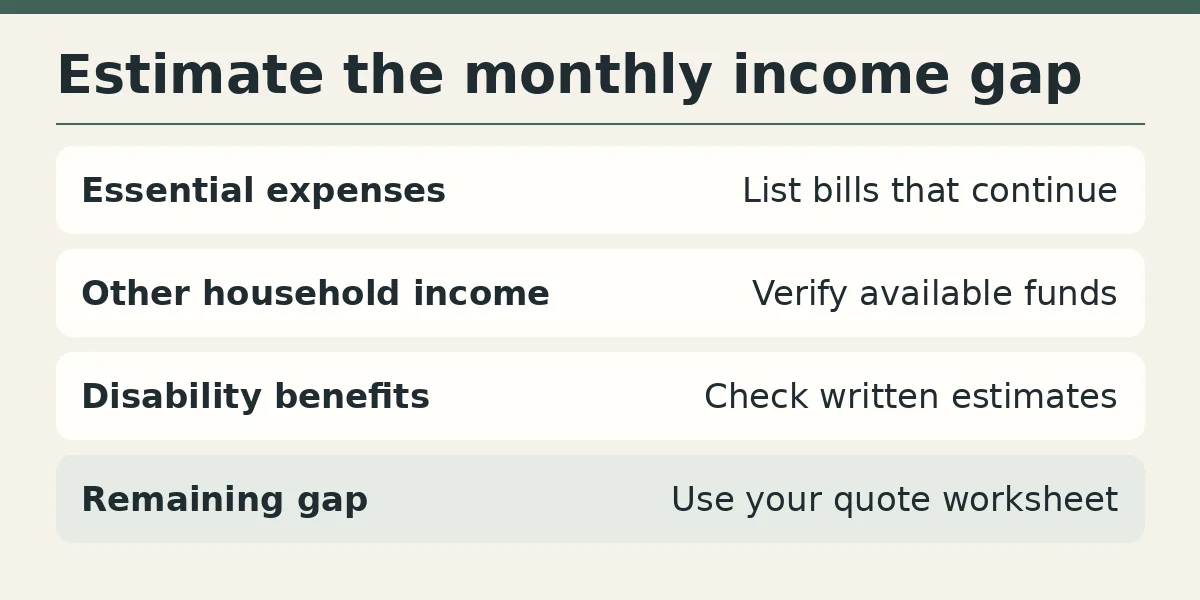
Write down essential household bills, debt payments, health coverage costs, and any expenses another household member could cover. Decide which savings you would be prepared to spend during the waiting period. Then compare that budget with any confirmed employer coverage. Ask the broker what income evidence it needs and how it determines the maximum amount you can buy. For a self-employed applicant, the carrier may consider forms of business income differently from employee wages. Do not assume a gross receipts figure matches the income it would use.
Suppose essential expenses are $4,600 a month and confirmed household income from another source would provide $1,700 a month. That leaves $2,900 in monthly expenses to fund. If a written employer plan estimate shows an additional $1,800 a month after relevant adjustments, the remaining amount would be $1,100 under those assumptions. A cash-flow gap of $1,100 does not automatically mean an insurer will issue that amount. Use the calculation to decide which options to request and get the carrier’s participation limits on other benefits in writing.
Compare own-occupation and other disability definitions
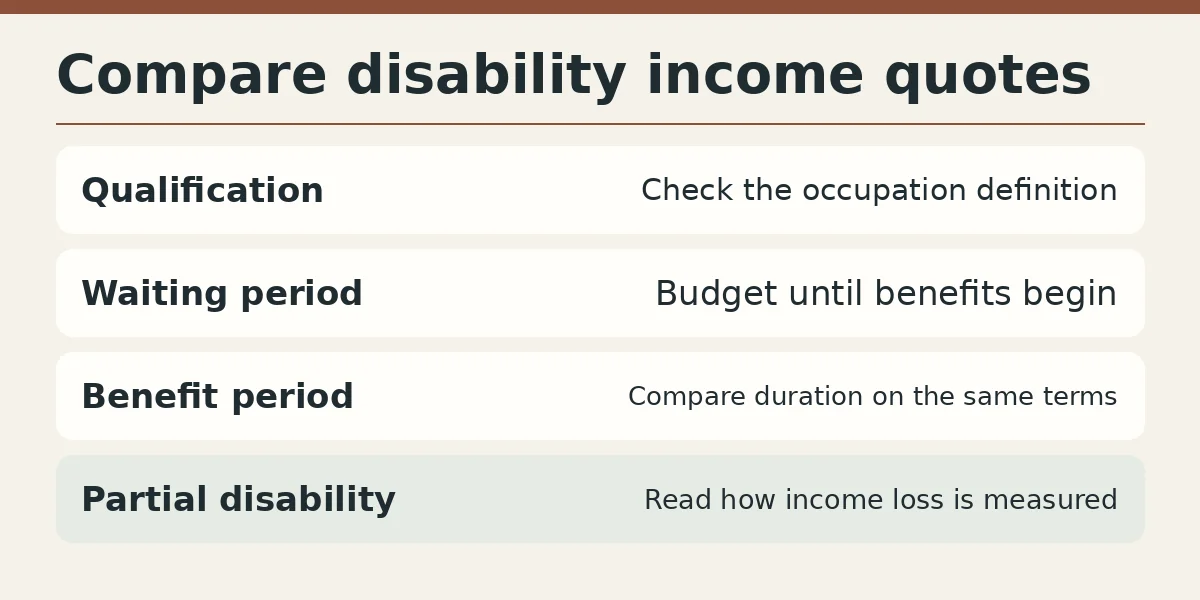
When comparing own-occupation disability insurance quotes, ask for a copy of the definition behind the label. A policy may assess your ability to perform the material duties of your own occupation, or it may consider another occupation for which you are qualified. Some contracts change the test after a specified period. Ask how the insurer treats another type of work or part-time duties. If two insurers use similar labels, request an example on each contract for your precise role.
For instance, a dental professional who can teach after losing the ability to see patients has a different financial situation from someone who cannot work at all. An architect who can still review plans but cannot perform field duties might also face a change in income or workload. Give each insurer the same factual description. Ask whether the form considers a specialty, office duties, field duties, working hours, or earnings. Record how the insurer says each example would be evaluated without relying on the example as an advance claim decision.
Compare waiting periods and benefit periods separately
An elimination period is a waiting period before benefits become payable under the relevant form. A benefit period describes how long the policy can pay an eligible claim, subject to continued qualification and other terms. Get both dates on each quote. Ask whether the carrier counts only consecutive days, whether it has rules for interruptions, and when it would issue the first payment once the waiting period is satisfied. Compare the monthly premium difference against the cash reserve needed during a longer waiting period.
Picture a household requiring $3,200 a month from savings while it waits. Extending a hypothetical waiting period from about 90 days to about 180 days could mean financing about three extra months. That is approximately $9,600 in this simplified budget before considering other income or variable expenses. Ask for premium quotes using the same monthly benefit and benefit duration for both waiting periods. Some applicants can comfortably finance the extra gap. For others, a shorter period is worth testing before accepting a lower monthly premium.
Read partial disability and return-to-work provisions
Ask whether a residual or partial disability provision is included or offered as a rider. Check how it measures lost income or duties and whether eligibility for partial benefits depends on an earlier period of total disability. Learn what earnings information might be required if work resumes gradually. Compare how benefits change as income recovers and whether the contract has a recovery provision after you return to work.
If you bill clients by the project, ask how the carrier distinguishes income received for earlier work from income earned after disability. If your earnings vary by season, ask which historical period it would consider. Save tax records, pay statements, and an accurate description of normal duties. A rider can add value for an applicant whose work could continue at reduced capacity, but its cost only makes sense once you know how the contract measures the reduction.
Compare premium guarantees and exclusions together
Ask how renewability and premiums are guaranteed and what conditions apply. Noncancelable and guaranteed renewable have specific meanings in the policy, and the period for each guarantee can matter. Ask whether a permitted increase would apply to a class of policyholders and whether any rider has a different price guarantee. Compare the yearly premium and any payment fees using the same coverage and effective date.
Read the issued exclusions and limitations, including any limits the insurer adds after underwriting. An initial proposal might assume a different classification or omit a condition that appears in the final offer. Ask for a revised comparison if the benefit, waiting period, or rate changes. Only provide sensitive underwriting information through the carrier’s approved channels. The Warwick term life quote comparison shows a similar way to keep estimated and issued policy terms separate when comparing life insurance.
Check employer offsets and benefits you would lose when changing jobs
Ask the employer plan administrator how a group benefit coordinates with state, federal, or other disability payments. Ask the individual carrier to explain its own coordination and participation rules. An advertised percentage can have a monthly maximum or a provision that reduces what is paid in a given situation. Use written plan materials when calculating an expected household payment. If there is a tax question about who paid a premium and how benefits would be treated, take the specific facts to a qualified tax professional.
If you expect to leave the employer or become self-employed, ask when group disability coverage ends and when an individual policy would take effect. A quote is an estimate. Confirm underwriting, issued terms, and effective dates before relying on new coverage. A household can compare disability income insurance and Warwick life insurance quotes as separate planning decisions because the contracts respond to different events.
Prepare for a claim using the policy’s instructions
Keep a copy of the issued form, any riders, list of exclusions, and claim contacts. Record what the insurer requires to document duties, income, and the date you stopped or changed work. Ask how to submit updated information if you return part-time or a medical provider needs to send additional documents. Each plan has its own notice and proof requirements. A calendar entry for the next action can help you avoid using one insurer’s instructions for another insurer’s policy.
Keep your Rhode Island TDI or employer correspondence in a separate part of the file. Ask each administrator which documents it needs and whether a determination under another program affects its contract. Save copies of what you submit and record when the administrator acknowledges receipt. A reliable record makes it easier to see where a payment decision came from if two carriers are involved.
Request disability insurance quotes for self-employed income
Collect tax returns and income statements that distinguish your pay from total business revenue. Ask the broker how the carrier considers the years you have been in business, fluctuations in earnings, and any owner draws or distributions. If you recently left a salary for contract work, tell the carrier when that changed. Compare each quote on the income amount the insurer has actually agreed to consider.
A business owner may also want to ask about business overhead expense insurance. That is a separate financial question about eligible expenses of keeping a business operating during a disability. Personal disability income insurance addresses the income needs of the individual. Ask for separate written quotes if both exposures matter. Check the benefit maximums and the list of eligible overhead expenses before treating a quote as help with a lease, staff payroll, or other continuing bills.
Price a long-term disability policy with optional riders separately
Ask the carrier for a base long-term disability insurance quote and the cost of each optional rider. Consider how you would compare a future increase option, partial benefit protection, or an eligible cost-of-living adjustment. Ask when an increase could become available, whether it requires fresh income proof, and what happens to the premium if you use it. For an inflation feature, read when an adjustment starts and whether its terms differ before and after a benefit begins.
Price one change at a time if you can. When you change the monthly benefit and the waiting period together, the savings you see will be hard to attribute. For example, someone choosing between $100 and $130 in illustrative monthly premiums can compare the $360 annual difference against a proposed rider’s benefit under one realistic case. If a policy offers a separate price for an extended benefit duration, ask how age and the contractual definition of disability affect when that extension matters.
Compare coverage if a bonus or a second job makes up part of income
Give the broker your base pay, any variable compensation, and income from secondary work as distinct amounts. Ask the employer plan which of those earnings it insures. Then ask the individual insurer to run two legitimate options based on the kind of income you can document. If your primary job already pays enough to cover fixed expenses, you may still want to estimate how replacing only the secondary earnings would change the budget during recovery. Review the definitions and participation rules before assuming extra pay is counted the same way in every policy.
Put every quote on one comparison sheet
Ask brokers to give you the same monthly benefit, elimination period, and benefit period. Add the actual disability definition, partial benefit formula, renewability terms, premium, limitations, and any offsets or participation rules. Request written answers for your normal occupation and for one realistic part-time return-to-work scenario. If an offer contains a rider for increasing coverage later, ask when it can be used, the income proof required, and how the added premium would be determined.
When a carrier issues an offer, match it against the numbers and wording you used in the comparison. Check the start date and any exclusions before accepting, then keep the issued policy separate from the preliminary worksheet. An individual disability insurance quote is most useful when it shows which loss of income the contract would cover, what amount it could pay, and how long you may need to fund your own expenses.
Sources consulted
Rhode Island Department of Labor and Training, TDI and TCI Frequently Asked Questions and 2026 TDI and TCI pamphlet. Wisconsin Office of the Commissioner of Insurance, Disability Income Insurance. North Carolina Department of Insurance, Consumer’s Guide to Disability Insurance.