
Employer life insurance can end when you leave a job in Rhode Island. Compare group life portability, conversion deadlines, and individual term costs.
Ask when your basic, supplemental, and dependent coverage ends. Obtain the group certificate and any continuation, portability, or conversion paperwork. Compare those offers with an individual term life insurance quote using the same amount and timeframe. Keep track of which coverage is in force while an application or enrollment is pending.
When does employer group life insurance end after you leave?
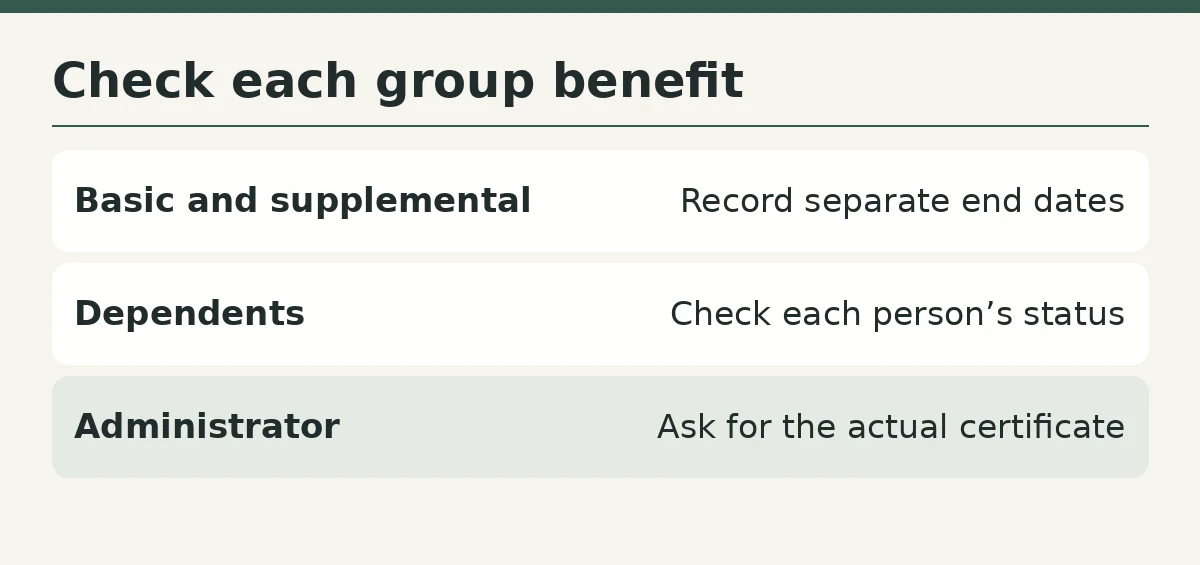
Ask HR or the plan administrator to identify the insurer, your certificate, the amount of each benefit, and the event that ends each one. Employment can end on one day and a benefit can stop on another, depending on the plan. Record which date applies to each covered person. Do not use the date of a final paycheck or an estimate from an enrollment screen as proof of coverage. Check whether you have individual coverage through a different carrier that remains in place.
Compare group life portability with an individual term quote
Ask the plan administrator for the amount eligible for portability or conversion and the exact deadline for paperwork. Request premiums for comparable benefit amounts and check how long each rate would apply. If an individual application is pending, ask when underwriting could finish and how that affects timing. The Warwick term life quote guide shows how to compare the individual policy’s duration and guarantee.
Group life portability versus conversion and individual term life
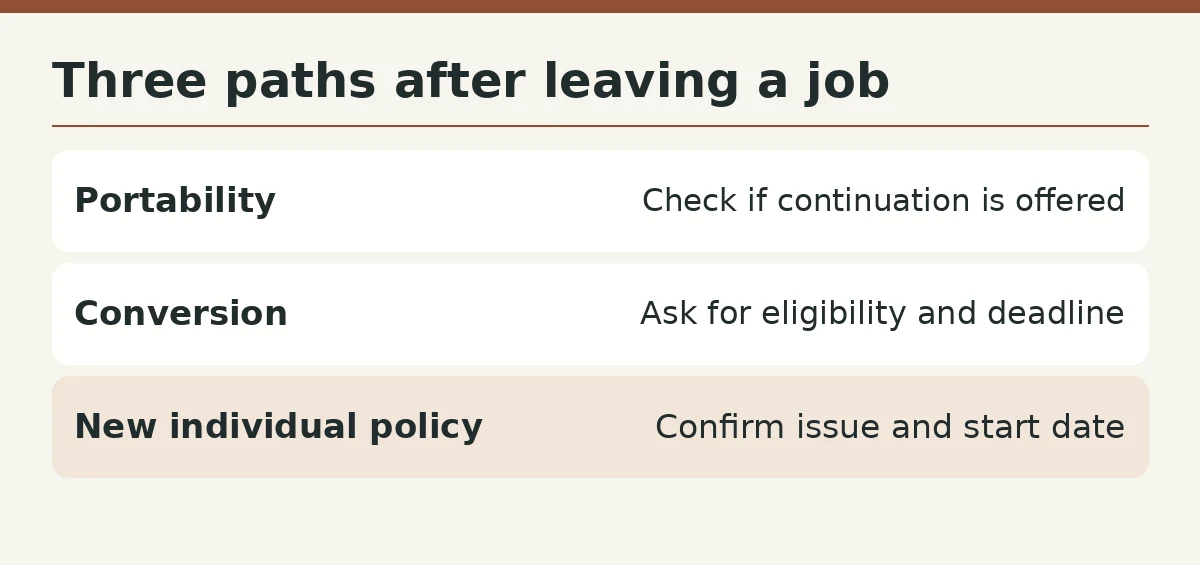
Portability, when offered, generally refers to continuing eligible coverage under the arrangement described by the plan. Conversion can refer to receiving an eligible individual policy under the group terms. A new application is a separate purchase with its own underwriting and start date. Ask which options are available for each benefit and request the written price, duration, and eligibility requirements. The individual term conversion guide is a separate reference for contracts with their own conversion right.
For group life policies subject to Rhode Island’s standard provision, certain eligible terminations can allow conversion without evidence of insurability when you apply and pay the first premium within the specified period, generally 31 days under the relevant provision. Conditions differ for some termination events and policy arrangements. Ask the insurer for the applicable deadline and notice provisions. An extension for an eligible late notice does not necessarily continue the underlying insurance. Confirm which dates and conditions apply rather than relying on an assumed deadline.
Use the same benefit in your comparison
Suppose employer coverage has $180,000 and personal coverage has $250,000. Before the change the nominal combined amount is $430,000. If the employer amount ends and the personal policy remains active, the nominal amount would be $250,000 until another policy is effective. Decide how much of the difference you would need to replace, how long you need it, and whether coverage offered by a new employer starts promptly. Keep beneficiary arrangements and actual eligibility in view.
Ask for the price of any eligible continuing benefit, the permanent policy available through conversion, and an individually underwritten term quote. Ask whether the upfront quote is estimated or issued. Compare how long each premium is guaranteed, which benefits continue, and what health questions apply. Use the Warwick term life insurance quote guide to align benefits and payment modes. Avoid treating a preliminary quote as active insurance.
Check deadlines and payment requirements for each insured person
Ask what the administrator needs for an application and what the insurer needs for the first payment. If a spouse or dependent is covered, ask which options extend to them and whether separate forms are required. Verify delivery instructions and save the receipt. If the administrator changes a date or you receive a revised notice, request the applicable terms in writing. Keep the existing certificate while the new arrangement is evaluated.
Ask who can confirm effective coverage. HR may be able to verify employment and group enrollment, while the carrier can confirm whether it accepted a particular continuation or conversion. Save both responses. Do not rely on a rate illustration, receipt of a form, or automatic payment initiation to prove the replacement was issued.
Review the beneficiaries and final policy documents
Use the Rhode Island beneficiary designation guide to check the accepted form for each policy. An employer plan and a personal policy may use separate records. Keep those records with names, benefit amounts, and insurance contacts. Tell a trusted person where to find them without placing personal identifiers in a shared file.
When you start a new job, ask when its benefits begin and what the enrollment deadlines are. Compare the policy you chose during the transition with the new employer’s offer. Check how the combined amount fits your household needs and whether any temporary arrangement continues automatically. Keep a dated record of which policies are active and who receives each payment.
Use a two-job timeline to identify a coverage gap
Imagine your last day is June 10, the group certificate says the benefit continues through June 30, and the new employer’s plan would begin August 1 if you enroll. Ask both employers to confirm those dates and the insurer to explain its options. Do not infer the end date from a paycheck or the first day of a new job. If the dates are confirmed, July would be an interval to evaluate. List any active individual insurance, then determine how much of your prior benefit would still be in force.
If you expect a spouse’s coverage to continue, ask for separate dates. The relevant certificate may describe eligibility for each person and different conditions for continuation. Ask which form and first payment the insurer needs for each election. A verbal description can omit a deadline or eligibility detail. Save the administrator’s response and verify receipt when you send paperwork.
Compare employer life conversion premiums with individual life insurance quotes
Say one option would continue $100,000 of a prior $180,000 benefit, and another quote addresses the full $180,000 under a different contract. Ask both companies to price the same benefit if available. Compare duration, expected premium changes, exclusions, any underwriting, and who issues the insurance. If the group insurer offers conversion without new medical evidence under applicable terms, record that separately from a new term application that may require underwriting. The cheaper preliminary offer may never be issued on the proposed terms.
Check a case where the benefit is needed for a mortgage or dependent rather than replacing it dollar for dollar. Review income, savings, and the duration of the obligation. Compare how much already remains from other coverage. A new employer may supply an amount much lower or higher than the previous one. Ask what employees can buy beyond the base amount and whether it requires a separate application. Do the comparison before the group election date.
Keep the paperwork through the first month of the new plan
Retain premium receipts, the insurer’s acceptance, and the new employer’s enrollment confirmation. Ask which document confirms that each policy is in force. Compare the effective dates and named beneficiaries. If one option ends automatically after a transition or has a renewal date, record it on the calendar. If a payment is missing, ask where the carrier posted it rather than assuming the application was denied or coverage began.
If a job change is close to retirement, ask what happens at that date as well. Employer coverage may be structured differently after retirement, depending on the plan. Request the terms for the correct status. If the carrier explains a state conversion rule, ask whether the group policy is subject to it and which circumstances trigger the right. Use what the carrier and documents actually confirm to review protection for the household.
Compare employer benefits in the same format as household needs
List basic life coverage, supplemental life coverage, any spouse benefit, and separate accidental death coverage on their own lines. Ask whether each amount has the same eligibility and end date. A benefit described in an enrollment page may have a different source from a personal term policy. Use the actual certificate and the insurer’s confirmation. Record which obligations would remain even if job-based coverage ends. A small benefit that continues cannot be assumed to replace the full prior amount.
For an employer plan that starts later than expected, ask about the cause of the delay and what enrollment action is still needed. Check whether supplemental coverage requires evidence of insurability and whether the insured amount differs during a waiting period. Do not cancel an existing policy based on an expected enrollment. Use the written confirmation after it is in force.
Check Rhode Island group life conversion deadlines and eligibility
Termination of employment, reduction of an eligible amount, a class of coverage ending, and retirement can be different events. Ask which one the carrier relies on and which benefit it affects. If the group coverage is issued or administered elsewhere, ask which law and documents apply. Request the applicable deadline with the amount eligible for conversion. Keep a separate note of any portability option and the insurer that issues it.
Ask whether the proposed policy includes the same death benefit and which optional benefits could carry over. Compare its price and payment method with an individual quote. If an offer only shows a monthly premium, calculate the overall cost for the period you plan to keep it. Ask what happens if the premium changes as you age or if employment at the next company ends. Save the actual terms rather than a brochure.
Write a two-column timeline for the household
On the left, record the old plan’s last covered day and date any application or payment must be received. On the right, record the new plan’s enrollment and effective date and the date the insurer confirms your status. Include the separate date for dependents, if relevant. Mark a date to follow up if proof has not arrived. If the group change happened because of a move, make sure the carrier can reach you after the old employer’s email or portal is closed.
Ask the administrator how a pending claim would be managed and who provides a copy of group records. Do not keep sensitive work documents in a place everyone can access. Preserve the plan certificate and insurer contact in a private file. If you obtain coverage through another carrier, update beneficiary and billing information independently.
Check the transition again at the next enrollment window
When your new employer holds its next enrollment period, review the coverage amount, premiums, and beneficiary records. Compare the policies you kept, continued, or purchased while you changed jobs. If a dependent’s eligibility changes, ask what notice and options apply. Put all active insurer names and policy numbers on a small index so a beneficiary can identify which record matters if a claim occurs.
Compare group coverage that ends with coverage that can be kept
If an employer offers both basic and supplemental insurance, ask whether each has the same eligibility for portability or conversion. A spouse or dependent benefit may have separate options. Request the contract and the cost for each choice. If a new employer offers a similar amount, compare start dates and any conditions first. Get current proof from the carrier when coverage begins and update the policy index at home. If continued insurance is only needed for a limited period, ask which payment and termination terms would apply. Put every deadline on the schedule for the relevant person and benefit.
If the employer changes insurers during the transition, ask which carrier is responsible for the group benefit that was in force when eligibility ended. Request its contact and claim or election instructions. Keep a dated copy of both certificates if they apply to different periods. The company offering the next employer’s benefit is a separate contact.
Build a job-change life insurance comparison
Get an end date for each group benefit. Confirm basic, supplemental, spouse, and dependent coverage separately and request the actual election deadline and form for each person.
Compare benefits on the same amount. Ask which options require underwriting, which contract would be issued, and how long the premium is guaranteed. Check the price of portability or conversion against an actual individual term offer.
Confirm coverage and payment. Ask when new insurance is effective, which payments are due, and who confirms acceptance. Review beneficiary designations on each policy after the transition.
If you request an individual policy, use the same benefit and term each time and ask how long underwriting could take. The Warwick Allstate life insurance quote guide explains how to record the issuing company, guarantee period, and effective date.
Sources consulted
Rhode Island General Laws §§ 27-4.8-5 and 27-4.8-6; National Association of Insurance Commissioners, Life Insurance Buyer’s Guide.