Compare car insurance quotes for a financed or leased car in Warwick. Match liability, lender deductibles, physical damage coverage, and optional GAP.
If you’re picking up a financed or leased car in Warwick, ask for the vehicle identification number and insurance requirements before delivery day. You’ll need coverage that meets Rhode Island’s rules and any additional requirements in your loan or lease. A written quote for the exact vehicle gives you a better purchase budget and time to fix any mismatch before you drive away (Consumer Financial Protection Bureau guide to insurance for financed cars). If Allstate is one of the carriers you’re considering, check what can affect its Warwick auto insurance rates.
Check the loan or lease before asking for quotes
State liability requirements apply to a registered vehicle. Your agreement may also require comprehensive and collision coverage, set a maximum deductible, and specify how to list the financing company. A lease may call for liability limits higher than the Rhode Island minimums. Read the actual agreement or ask for its insurance section in writing.
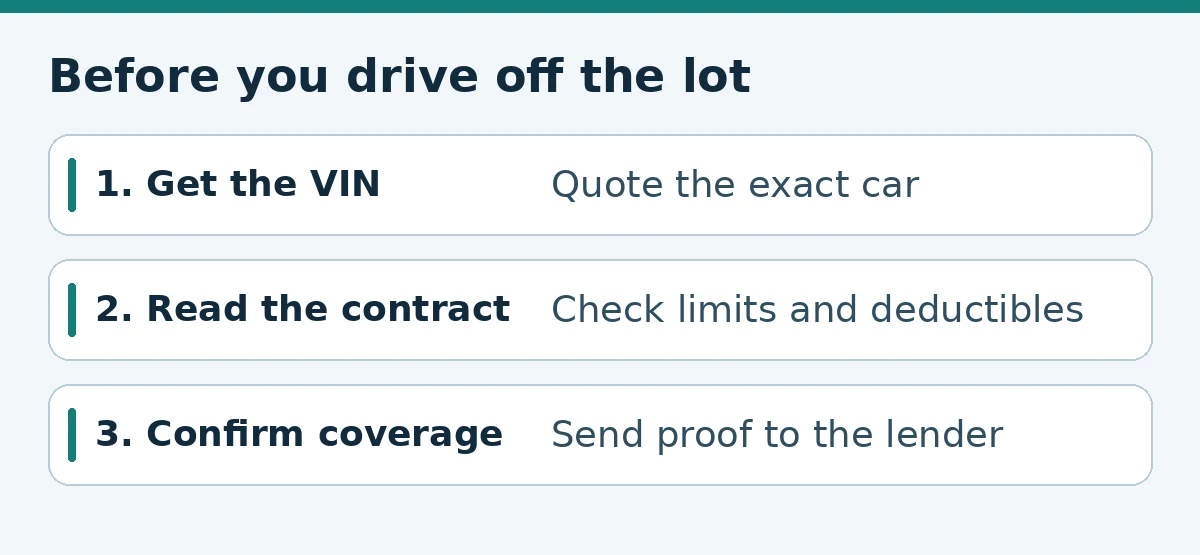
Tell each insurer the VIN, where you’ll keep the car, who will drive it, and how you’ll use it. Ask for the same effective time, limits, and deductibles. If your lender caps the deductible at $500, a cheaper quote with a $1,000 deductible may require a revision before the lender accepts proof. A quote for an older trim or a similar model can also change when you supply the final VIN.
Separate a GAP quote from monthly financed car insurance costs
Ask the dealer and insurer for written terms on any loan or lease payoff option. Compare eligibility, limits, and exclusions. If a dealer option would be added to the loan, request the amount financed and review how that changes the borrowing cost. Compare the auto policy separately under the lender’s deductible rules. The loan payoff insurance guide explains which decisions you can revisit later.
Ask how coverage changes when you trade in a car
A trade-in gives you two sets of paperwork to check. Ask the dealer when it takes possession of the old car and when you’ll be able to drive the replacement. Give those dates and the new VIN to your insurer. If the dealer postpones delivery or changes the vehicle, call the insurer before relying on the document it sent. Some policies have provisions for a newly acquired vehicle. Ask your insurer which coverages would apply, when notice is due, and whether the provisions satisfy the lender’s terms. Confirm coverage for the exact vehicle before it leaves the dealership.
The lender and dealer may give you different forms. Find the lender’s insurance instructions and match the name and address on the proof of coverage to those instructions. For a lease, ask how the lessor must be listed and whether the lease has additional liability or deductible requirements. If you need to make a change, request a revised binder or declarations page and check the updated information yourself. Keeping a dated copy makes it easier to answer any later question about whether the policy was in force.
How collision, comprehensive, and GAP fit together
Collision coverage can apply to covered damage from a crash. Comprehensive coverage can apply to losses such as theft or hail. If the car is totaled or stolen in a covered loss, the insurer’s settlement is generally based on the vehicle’s value and policy terms. The balance on your loan can be higher, particularly early in a long loan or if you rolled in debt from a trade-in.
Consider a car with a $23,000 cash value at the time of a covered total loss. If the primary insurer pays $22,500 after a $500 deductible and your loan payoff is $26,000, the difference is $3,500 before considering any GAP terms. An eligible GAP product could cover some or all of that difference. Contracts may limit reimbursement or exclude items such as a deductible, late payments, or certain amounts rolled into the loan. Ask whether a lease already includes a GAP waiver and how a separately purchased product is priced (CFPB explanation of GAP coverage).
Compare the cost and eligibility rules of GAP offers
If the loan balance is likely to exceed the car’s value early in the term, ask how a GAP product would handle that period. A small down payment, a longer repayment term, or negative equity carried from a trade-in can affect the amount you owe relative to the value of the replacement car. Request a written copy of the GAP terms before signing. Check the maximum benefit, any restrictions on the size of the loan relative to the value of the vehicle, and whether items added to the loan count toward a covered balance.
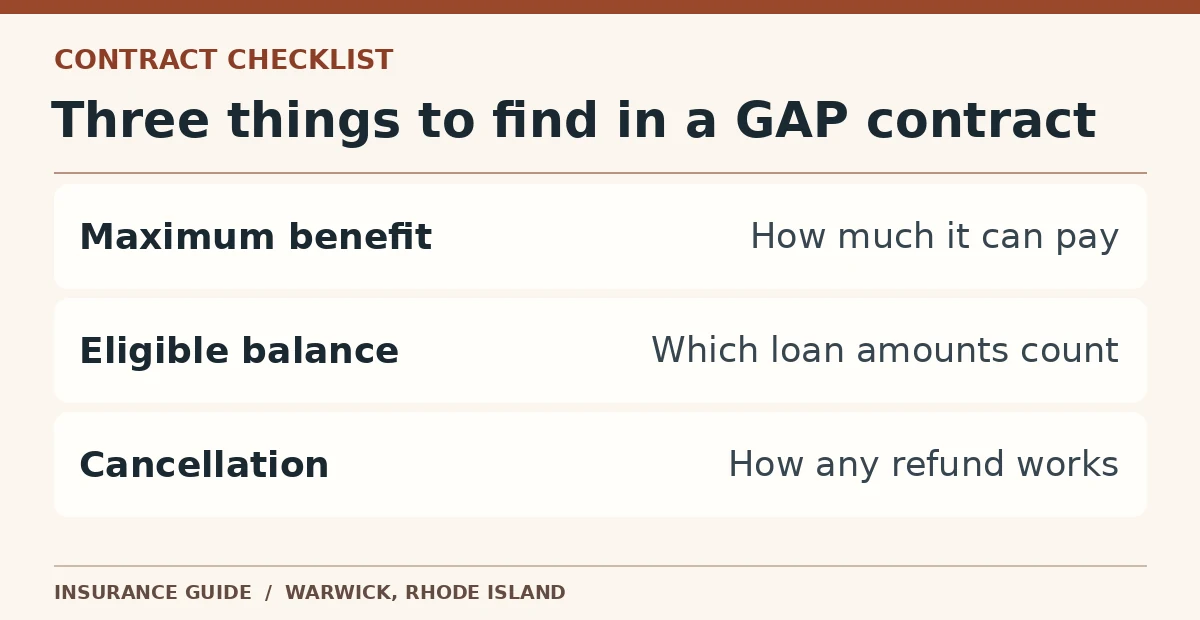
Compare the total cost under the options available to you. For example, a dealer might offer a $600 GAP product that can be added to the loan. Ask the lender for the financing figures with and without it so you can see how the additional principal changes the interest you would pay. If an auto insurer offers a related add-on, ask how it defines the covered shortfall and what happens if you change insurers. Ask the seller how cancellation and any refund would work if you refinance, pay off the loan early, or sell the car. Keep the contract and the steps for making a claim with your auto policy (CFPB consumer guidance on optional GAP products).
Get a copy of the final loan or lease paperwork and review all add-ons before signing. The insurance contract, financing agreement, and GAP terms can each answer a different question after a total loss. Make sure you know who issues each document and whom you would contact first.
Confirm proof of coverage before pickup
Ask the insurer for an insurance card or binder and have the lender or dealer confirm that it accepts the document. Verify the VIN, coverage start time, and lienholder or lessor information. If you’re replacing an insured vehicle, ask when the old car should come off the policy. A lender may purchase force-placed insurance if required coverage lapses, and that coverage generally protects the lender’s interest. Keep the policy current and save the proof you send.
If the monthly payment is close to your budget ceiling, price the insurance and any optional GAP product before you agree to the financing. Use the Warwick car insurance quote comparison guide to compare carrier prices with the same contract-compliant coverage.
Request lender-compliant auto insurance quotes before delivery
Give carriers the exact VIN, pickup time, lender instructions, and maximum deductible. Match collision, comprehensive, and liability amounts before comparing premiums. Treat GAP as its own purchase decision and ask about eligibility, exclusions, and the cost of financing it. Use the auto loan payoff guide to identify what can change after the lien is released.