
Compare renters insurance quotes in Warwick, RI. Set personal property and liability limits, then check replacement cost and temporary housing terms.
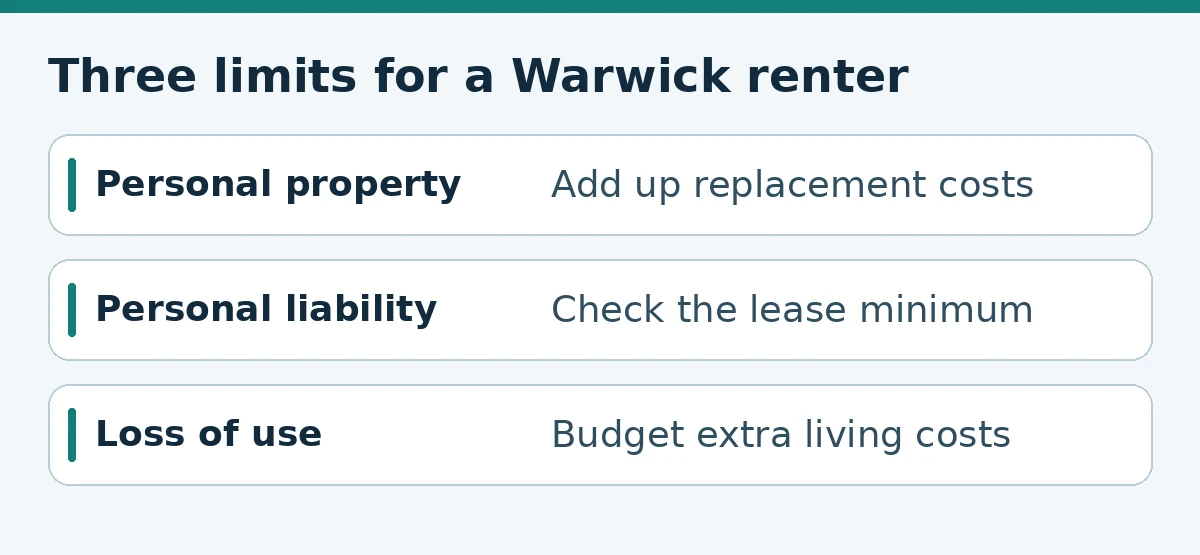
The amount of renters insurance you need in Warwick starts with three separate figures: what your belongings would cost to replace, what liability limit your lease asks for, and what extra expenses you could face if a covered loss forces you to leave your apartment. A landlord’s property policy generally covers the building owner’s interests. Ask for a quote that shows your own personal property, personal liability, and loss-of-use limits separately (NAIC renters insurance guide).
Take a room-by-room inventory before picking a limit
Start with the bedroom and living room, then open closets and cabinets. Add clothing, kitchen supplies, small appliances, linens, and electronics. Use a reasonable price for a new equivalent of each item. Photograph higher-value belongings and keep receipts or serial numbers in a location you can access if you lose your phone or laptop (NAIC home inventory guidance).
For example, suppose it would cost $6,000 to replace your furniture, $4,000 for clothing and linens, $3,000 for electronics, and $5,000 for kitchenware and other belongings. That’s $18,000 before any policy deductible or special limits. Ask about quotes above and below that figure to see how the premium changes. A lease requirement of $100,000 in liability coverage tells you nothing about how much property coverage you bought.
Test renters quotes against one expensive item
Select one item you would need to replace quickly and estimate the cost of a current equivalent. Ask each carrier to show how its renters policy would value that item in an eligible loss and which deductible or special limit applies. Compare the answer with the added premium for replacement cost or a separate rider. Use the Warwick jewelry insurance comparison if the item is a ring or watch.
Check replacement cost, the deductible, and special limits
Replacement cost coverage generally bases reimbursement on what it costs to replace a covered item with a comparable new item, subject to the policy. Actual cash value usually takes depreciation into account. A worn couch could produce a smaller actual-cash-value payment than a new equivalent costs. Some replacement-cost policies also pay actual cash value first and release additional money after you replace the item and submit documentation. Ask about the timing, deductible, and any purchase deadlines (NAIC explanation of replacement cost and actual cash value).
Read the special limits for valuables such as jewelry and ask whether they apply to the loss you’re concerned about. If you have a roommate, ask who the policy names and whose belongings it covers. Keep the lease’s insurance addendum so you can check whether the landlord requests a particular liability limit or proof of insurance.
Ask how a belongings claim would be paid
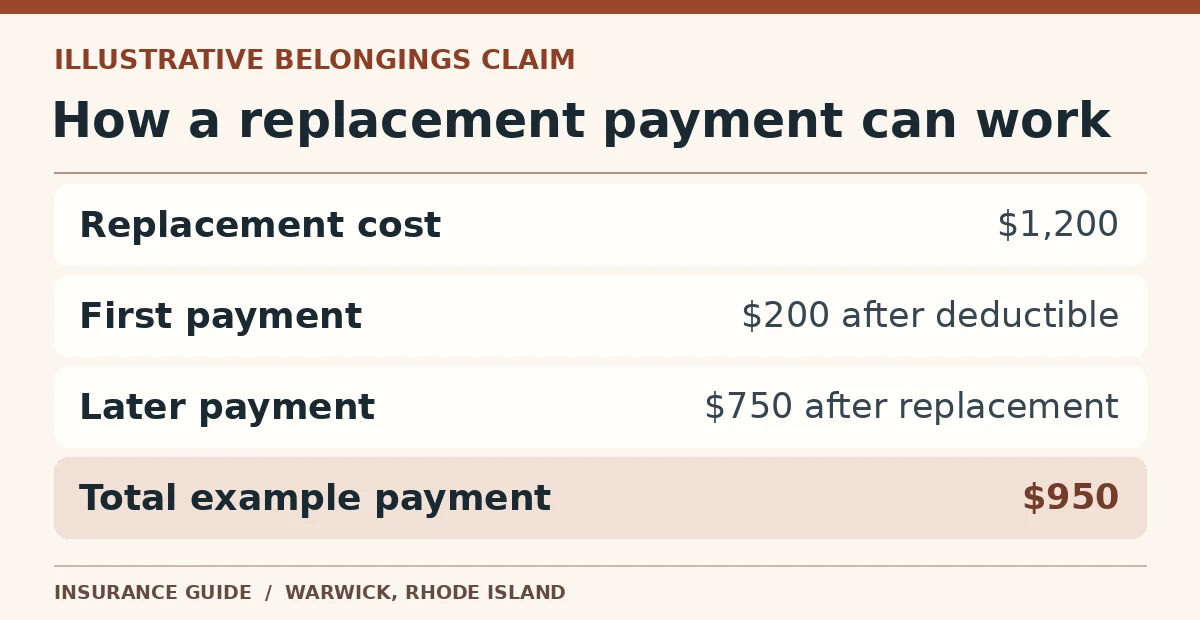
Use one item from your inventory to test the settlement terms. Suppose a covered loss destroys a laptop that costs $1,200 to replace and has a $450 actual cash value under the insurer’s estimate. If a $250 deductible applies and this is the only item in the claim, the actual cash value payment would be $200. Under a replacement cost policy that pays in two stages, an insurer might pay the $200 initially and then another $750 after you submit eligible proof of replacement. The total would be $950 in this example. Limits, valuation, deadlines, and the contract affect actual payments (NAIC guide to actual cash value and replacement cost).
When asking for a quote, pick a valuable item as a second example. Find out whether there’s a special limit for the kind of loss you’re concerned about. Ask whether you would need separate scheduling or an endorsement and what documentation the insurer wants. A large personal property limit on the declarations page may still leave a smaller amount available for a specific category of belongings.
Include items you regularly keep away from the apartment when you make the inventory. A bicycle might sit in a shared basement, or seasonal belongings might be in a rented storage unit. Tell the insurer where those items are kept and ask about any off-premises limits, security conditions, and exclusions. Write down the addresses and keep photos of the items so you can identify which property was affected if you file a claim.
Read the insurance clause when you sign or renew a lease
Find the required liability limit, when coverage must start, and what proof the property manager needs. If the lease asks you to list the landlord or manager on the policy, send the exact wording to the insurer and ask which designation it can provide. Get confirmation from the property manager that the document satisfies the lease. Keep a copy of the certificate or declarations page you sent and the date it was accepted. If you also carry personal umbrella insurance, check its minimum underlying renters liability limit.
If you share the apartment, check each roommate’s coverage separately. Ask who qualifies as an insured person, whether a roommate needs their own policy, and how the company handles belongings in a shared room. Review the quote again if someone moves out or if you transfer to another unit. The apartment address and names on the policy should reflect the household you’re insuring.
Budget for temporary housing after a covered loss
Loss-of-use coverage can help with qualifying extra expenses if a covered loss makes your rental uninhabitable. If you normally spend $400 a week on rent and a temporary place costs $750 a week, the housing difference is $350 a week in a simplified example. Ask what the policy considers an extra expense, how it treats rent you still owe or no longer owe, and what dollar and time limits apply. Save receipts if you have to relocate.
Keep the records you would need if you had to move out
Store a copy of the inventory, your lease, and the policy somewhere you can reach from another device. If a covered loss forces you to move, ask the insurer how it evaluates hotel stays, temporary rentals, and additional food or transport expenses. Record your normal expenses as well as the extra ones and save itemized receipts. If repairs take longer than expected, ask how much loss-of-use coverage remains and whether a time limit applies before you commit to a longer temporary lease.
Use your inventory and the lease to request the same limits from each insurer. The site’s Allstate renters insurance overview for Warwick covers one provider to include in that comparison. Ask each insurer to show in writing how the quote values your belongings and what it excludes.
Compare renters insurance quotes against your lease and inventory
Give each carrier the same personal property limit, deductible, and valuation method. Compare written quotes with the liability requirement in your lease and ask how additional living expenses would be calculated. If high-value items drive the estimate, check a jewelry insurance quote separately because special limits can apply.