Compare HO-6 condo insurance quotes in Warwick, RI. Check the association’s master policy, unit improvements, deductible, and loss assessment limits.
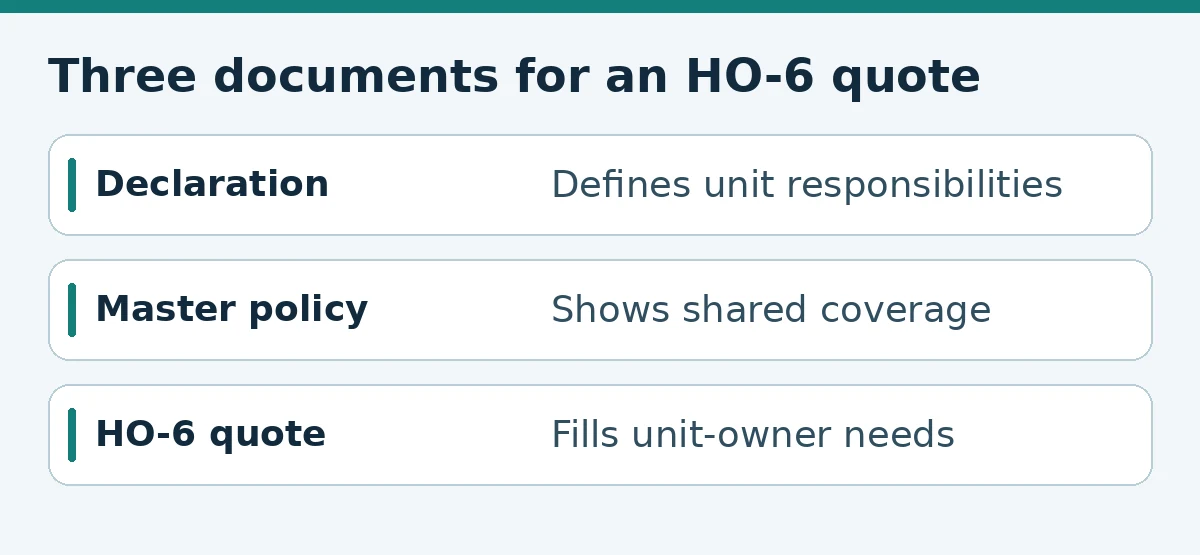
The most useful document to bring to a Warwick condo insurance quote is the association’s master policy, alongside the condominium declaration. Together, they help your agent see which parts of the unit the association insures and where an individual HO-6 policy may need to respond. Ask for the master policy’s declarations and relevant endorsements, plus the association rules on deductibles and loss assessments. A one-page certificate rarely answers all of those questions (Condo unit insurance overview).
Determine who insures the finishes and upgrades
Rhode Island’s condominium law includes rules for association insurance. For buildings with horizontal unit boundaries described in the declaration, the association’s property coverage generally includes units to the extent reasonably available, though it need not include unit-owner improvements and betterments. Where the association insures the units, the law also addresses unit owners’ coverage for certain improvements and the association deductible, to the extent reasonably available. Ask the association and your agent how those rules apply to your building (Rhode Island Public Laws, Chapter 177, amending § 34-36.1-3.13).
Walk through your unit and list the improvements you own, such as upgraded cabinets, counters, flooring, or built-in fixtures. Find out whether the master policy covers the original finishes, upgrades, or both. Give your agent a realistic estimate of what you would have to rebuild and ask how the quote covers those items. The purchase price includes the location and other factors that have little to do with replacing the finishes inside the unit.
Price loss assessment on two HO-6 condo insurance quotes
Send both carriers the same master declarations, applicable association deductible, and written assessment provision. Ask which loss assessment forms they would use and how each form would treat a covered assessment tied to the master deductible. Price the difference between two offered limits on otherwise matching HO-6 quotes. If you are estimating the unit improvements you insure, see the replacement cost worksheet for the valuation inputs.
Map a water loss to the relevant documents
Suppose a pipe in a common wall bursts and damages shared drywall, upgraded flooring in your unit, and your sofa. Start with the condominium declaration and the master policy. Ask the property manager who is responsible for the common wall and which finishes the association insures. The HOA’s responsibility to repair a component and the insurance available to pay for the repair can depend on different provisions. Give your HO-6 insurer the same facts so it can tell you which items its policy may cover and what information it needs.
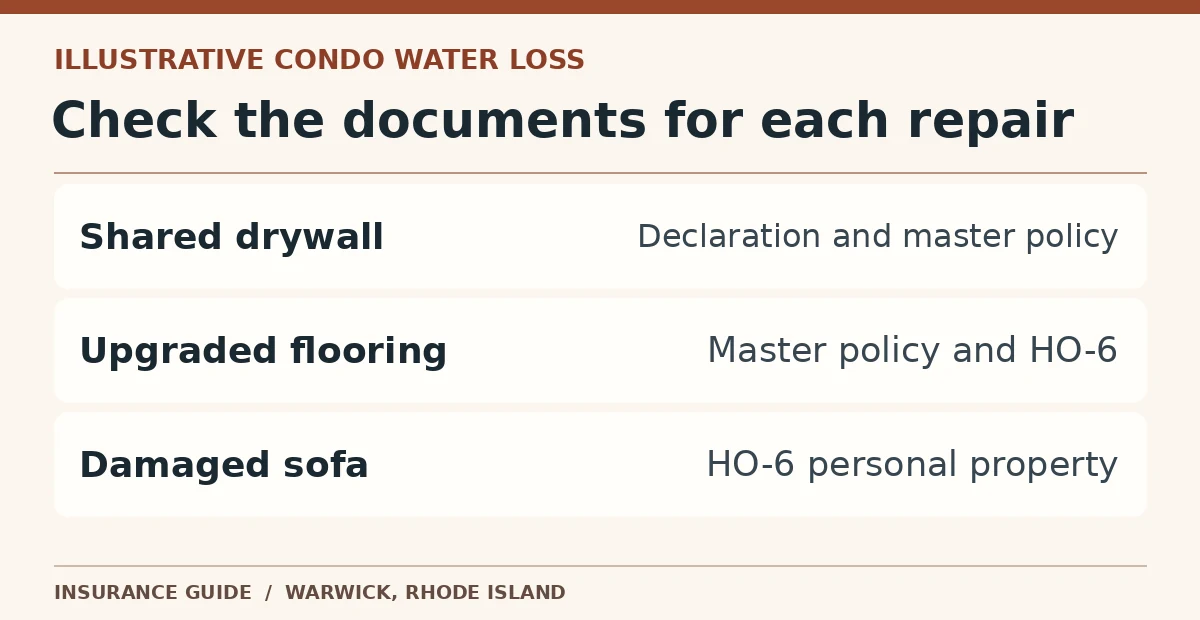
When comparing condo insurance quotes, walk through that example for each policy. Check whether your upgraded flooring would be considered building property under the unit policy and how it would be valued after a covered loss. Ask about the policy’s treatment of your sofa and other belongings as personal property. If the quote mentions a water exclusion or a limit for water damage, ask whether it applies to the scenario you described. Keep the policy wording handy so you can check the answers later (Insurance commissioner’s guide to how a master policy and HO-6 policy work together).
Ask about the association deductible and loss assessments
A master policy deductible is the amount deducted from a qualifying loss under the association’s insurance. An assessment is an amount the association may allocate to owners under its governing documents. Those amounts can be related. For example, after covered water damage the association might allocate part of its deductible to the affected unit. Ask the HO-6 insurer whether the quote covers that charge, which limit applies, and what exclusions could affect payment. Separately ask which assessments tied to common-area damage are covered and whether the policy uses a different limit.
Check which assessment limit could respond
Imagine your association allocates $8,000 to your unit after a covered event. A quote might show $25,000 in general loss assessment coverage and a smaller limit for assessments tied to a master policy deductible. Ask which limit would govern this example, what event the assessment must arise from, and what documentation is needed from the association. Ask the property manager how the governing documents allow costs to be allocated and whether they distinguish damage to a unit from a loss affecting common property.
In Rhode Island, the applicable condominium statute addresses certain unit-owner insurance obligations when the association maintains property insurance on the units. Give your agent the current declaration, bylaws, and the association’s insurance information so they can evaluate the arrangement for your building. A policy summary from another condominium, even in the same neighborhood, can leave you budgeting for the wrong deductible or amount of unit coverage (Rhode Island General Laws § 34-36.1-3.13).
Before a purchase or renewal, ask whether the master policy deductible has changed. If you’ve upgraded the kitchen or replaced the flooring, update the list of improvements and ask the insurer to price your new rebuilding estimate. Save the latest documents together so a claim can be evaluated against the terms in effect when the loss occurred.
If the water loss makes the unit temporarily uninhabitable, ask your HO-6 insurer how it evaluates additional living expenses while the association and unit owners coordinate repairs. Ask about any limit on dollars or time and what proof the insurer needs. A delay in shared-wall repairs can affect when you can move back. Keep the association’s repair schedule and any temporary housing receipts with your claim records.
Review four lines on the HO-6 quote
- Building property. Check the limit for the unit fixtures and improvements you’re responsible for.
- Personal property. List furniture, electronics, and other belongings. Ask whether the policy values them at replacement cost or actual cash value.
- Loss of use. Ask how long the policy could cover qualifying extra expenses if a covered loss forces you to move out.
- Personal liability and loss assessment. Review each limit separately and ask what triggers each coverage.
If your condo is near a flood-prone area, ask the association for its flood policy or written confirmation of its coverage, then review flood insurance options in Warwick. If you’re buying with a mortgage, ask the lender which master policy and HO-6 documents it needs while you’re preparing insurance for closing. Keep those documents together with your quote so you can revisit your limits if the association changes insurers or raises its deductible.
Compare HO-6 coverage on the same master policy documents
Give each carrier the same declaration and master policy, plus a list of owner-installed finishes. Ask which limit applies to a loss assessment arising from the master deductible and whether the policy treats a different association assessment separately. See how replacement cost estimates work before agreeing on a limit for the part of the unit you insure.