Compare contractor general liability insurance quotes in Rhode Island. Check contract limits, exclusions, certificates, and the full-term premium due.
Get the estimate or contract for the next job before calling for quotes. It can tell you which companies must be listed, how much insurance the customer requires, and when coverage must begin. Give each insurer the same description of your work. A quote for interior painting has a different set of assumptions from a quote for a business that also repairs roofs or hires subcontractors.
Start with Rhode Island contractor registration
The Rhode Island Contractors’ Registration and Licensing Board instructs first-time applicants for general contractor registration to supply a certificate of general liability insurance showing at least $500,000 in coverage and naming the Board as certificate holder. Rhode Island General Laws § 5-65-7 describes the amount as a combined single limit for bodily injury and property damage and generally requires the applicable insurance throughout registration. The Board also instructs applicants with employees to submit proof of workers’ compensation. Confirm current rules, class of registration, and certificate instructions with the Board for the work your business performs.
A builder, general contractor, property manager, or commercial customer can ask for higher policy limits than the registration minimum. Compare the state requirement and the job’s insurance agreement separately. Look at renewal dates as well as the date work begins. If the project runs past renewal, make sure the certificate and insurance proof can be updated without interrupting the job. For background on how changes to a building itself can affect insurance, use the Warwick renovations and builders risk guide.
Compare contractor general liability quotes on one signed project scope
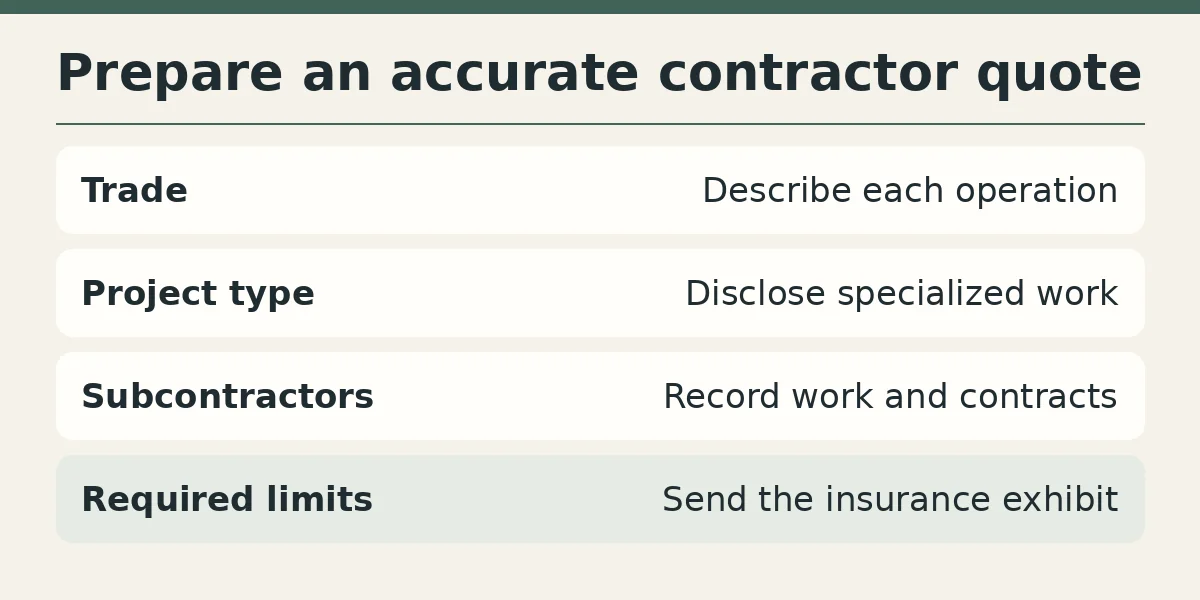
Send every broker the same trade, projected sales, subcontractor costs, and insurance exhibit. Have each identify completed operations, any required endorsements, and how an audit could change the final premium. Include the legal entity and job dates to test whether the certificate would meet the contract. If you also need coverage on the work itself, use the Warwick builders risk guide to request a separate price.
Identify the work the policy will actually insure
Ask the broker to list all of the operations included in its submission. Give it a realistic breakdown by trade, project type, and revenue. Include subcontracted work, whether you act as general contractor or trade contractor, and any work that involves roofs, excavation, or occupied buildings. Ask which classifications the insurer uses and how it handles incidental tasks. A business that replaces a small section of siding once a year can still need to disclose that activity to avoid relying on an inaccurate quote.
A commercial general liability policy commonly addresses certain third-party bodily injury and property damage claims from insured operations, subject to its terms. Ask how the form treats defective work, the part of the property you are working on, and damage that results after a job is finished. A contract may require completed operations coverage for a defined period. Ask the broker to explain those terms using an example tied to the kind of project you take on.
Compare each-occurrence and aggregate limits
The each-occurrence limit and the aggregate answer two different questions. An occurrence limit can cap the amount for a covered occurrence. The aggregate can cap what the carrier pays for a defined group of claims during the policy period, subject to the terms. Some quotes show a separate limit or aggregate for products and completed operations. Ask which one applies to an allegation about a completed job and which applies when several customers make unrelated claims.
Suppose a sample policy shows a $1 million each-occurrence limit and a $2 million applicable aggregate. If prior claims have already used $1.6 million of that aggregate, only $400,000 might remain for another loss in the same aggregate, subject to the policy’s wording and what was charged to it. A customer who requires a separate per-project aggregate wants to know how the applicable limit is allocated. Ask whether a specific endorsement is required and check whether the quote includes it. Also ask how defense costs and any deductible or self-insured retention interact with the limits.
Request a certificate alongside the applicable endorsements
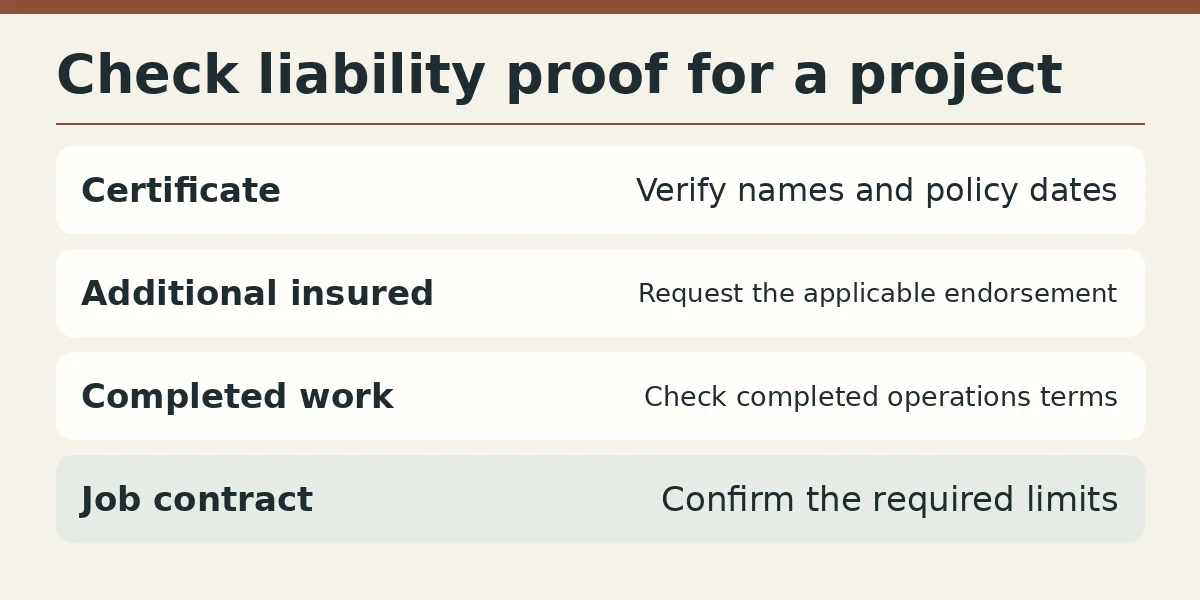
A certificate of insurance summarizes specified policy information. When a customer asks to become an additional insured, ask the broker which endorsement would provide that status and under what conditions. Being named as certificate holder and being covered as an additional insured serve different purposes. Request the required endorsement, including any form needed for ongoing and completed operations, and verify how it applies to the customer and job.
Contracts sometimes request additional terms such as primary and noncontributory treatment or a waiver of subrogation. Give the entire insurance exhibit to the broker before accepting it, so the broker can identify anything the policy would require adding or could not provide. Check the full legal names, address, policy dates, and job reference before sending the certificate. Ask who can issue a correction and how long it takes. If your job has a homeowner or lender asking for other kinds of insurance proof, the Warwick guide to verifying insurance documents gives examples of what information to confirm with the party requesting the proof.
Review exclusions for subcontracted and specialized work
Ask which exclusions or conditions apply to your kind of projects. Possible areas to review include residential work, roofs, work above a specified height, water intrusion, pollution, and projects involving subcontractors. Ask how the policy treats work you supervise but do not do yourself. If the forms require written agreements or proof of insurance from subcontractors, ask the broker for the policy conditions before the start date so the office can keep consistent records.
Use the same example for every quote. A subcontractor working in an occupied Warwick duplex damages a water pipe and water enters another unit. Ask each broker which facts are needed to consider an insured loss, such as who hired the subcontractor, what work had been started, and who was responsible for the damaged property. Ask how your own policy might respond and what role the subcontractor’s coverage could play. If the owner also purchases protection for the rental, the Warwick landlord insurance guide explains how to compare its dwelling and loss-of-rents terms separately.
Price general liability alongside adjacent coverage
An owner with power tools, a van, and employees needs separate answers about those risks. Ask how tools are insured at the shop or on a job site and what happens when they are left in a vehicle. Workers’ compensation addresses eligible work-related employee injuries under applicable rules. Ask the relevant Rhode Island authority or a licensed agent how its rules apply to the people you hire. A broker can also quote commercial auto separately and review vehicles owned by the business or used for work.
Other exposures may require their own forms. Pollution, professional services, or project property can need separate treatment. Ask about commercial umbrella or excess liability if a customer wants higher limits. Find out which scheduled underlying policies it would sit over and whether it contains its own project exclusions. For differences between personal and business liability, see how personal umbrella insurance in Rhode Island handles the household exposures it is designed for.
Ask how payroll or sales will affect the final premium
Ask what the quote uses to rate the business. Depending on the insurer, exposures can include estimated payroll, revenue, or subcontractor costs. Confirm how the carrier would verify those amounts and whether the policy is subject to audit after the term. Ask which records to save, how uninsured subcontractor labor could change the calculation, and whether any premium is retained as a minimum. Do not rely on the first installment as the price of the insurance.
As an illustration, a $2,300 quote estimated on lower projected revenue can look cheaper than a $2,650 quote based on expected work for the whole year. Ask both brokers to rerun the quote using the same figures. Compare taxes and fees, down payment, installments, cancellation terms, and realistic audit exposure. If one company asks for an exclusion to reach a lower premium, give yourself time to calculate the cost of leaving that work outside the policy.
Set up the insurance records before signing the next job
Prepare one folder containing issued policies, forms, certificates, project contracts, and the names of the people handling changes or claims. When you quote a new job, check that the legal entity signing the contract is the one the policy actually insures. Ask what to do if you add a trade, open a second location, or hire a subcontractor outside your usual scope. Save the carrier’s written confirmation when the operation is added.
Store the first and last approved dates for each endorsement with the certificate. If a customer requests updated paperwork during a project, you can check the dates and limits with the broker quickly. If a written claim arrives after the job, keep the relevant contract, work records, and photos and report the matter using the policy’s designated channel. A dated record of repairs and communications allows the carrier to match the alleged damage to the right project and policy period.
Ask for trade-specific commercial insurance quotes
If concrete, painting, flooring, and carpentry bring in revenue, provide the breakdown on the same dated worksheet to each broker. Ask the carrier how it rates a general contractor who hires mechanical trades and whether it distinguishes work performed by employees from work passed to another company. A general liability insurance quote for a handyman business can look attractive beside one written for a general contractor until you compare which jobs each actually includes.
A contractor with a van can also request a commercial auto insurance quote using the business’s actual vehicle title, drivers, use, and mileage. Ask about transporting tools and rental vehicles in a separate call. If a crew uses a personal pickup to tow a trailer, ask the broker to explain how both the personal and commercial contracts would treat the situation. Keep vehicle premiums separate when comparing liability quotes, then add them back to budget for the total package.
Check whether a business owner’s policy fits the equipment and premises
Ask whether a business owner’s policy is available for your operations. Some eligible packages combine general liability and commercial property coverage. Depending on the form, a package can also include or offer business income coverage. Check which buildings, stock, and tools qualify, the stated addresses, and whether tools at a job site need another form. For leased space, read the landlord’s insurance clause before selecting property limits.
A standalone general liability quote can be appropriate for an operation with modest property needs. For contractors with costly equipment or a storage shop exposed to theft and fire, request a package quote and a separate tools coverage quote. Compare policy limits, property deductibles, coverage in transit, and interruption protection. An itemized proposal makes it possible to select the best combination for your business when one carrier writes the liability and another offers more useful property coverage.
Compare the cost of increasing the liability limit
If a new customer requires more than your current policy, ask the broker for two written prices. Request a higher general liability limit where available and a commercial umbrella or excess liability quote over the underlying policy. Identify which quote accepts the customer’s requirements, which underlying policies it uses, and how it treats completed operations. When a change is only needed for one project, ask whether the option is tied to the full policy term and whether restrictions would carry over to other jobs. Compare the difference with the contract value before ordering a certificate.
Use a written quote comparison for the final decision
Send each carrier the same information about trade, projects, payroll, receipts, subcontractors, and locations. Ask for the price by term, limits, completed operations treatment, exclusion forms, and specimen endorsements. Give the most important upcoming contract to the broker as a test. Ask which requirements each quote satisfies and what it would cost to add the missing endorsements. If an insurer cannot offer one required term, find that out before you put a date in the customer’s calendar.
After the policy issues, compare the quote with the declarations and endorsements. Check the correct entity name, listed business address, classifications, and coverage start date. Confirm you can obtain any required paperwork and get a revised certificate after material changes. The purchasing decision is complete when the written policy aligns with the actual work, the applicable registration requirements, and the contracts the business plans to accept.
Sources consulted
Rhode Island Contractors’ Registration and Licensing Board, General Contractor Registration and Contractor FAQs. Rhode Island General Laws § 5-65-7. Federal Deposit Insurance Corporation, Money Smart for Small Business, Insurance Participant Guide.