Read your Rhode Island auto insurance declarations page. Check drivers, VINs, liability and UM limits, deductibles, and coverage on each insured car.
The auto insurance declarations page is the fastest place to check which cars and drivers a Rhode Island insurer has on file and what it has charged for each coverage. You may receive it as a PDF with your new policy or renewal. Start with the version that is in force for the date you care about. A quote shows proposed coverage, an insurance card shows proof for a vehicle, and the declarations page summarizes the issued policy. The policy form and endorsements explain how those selections work in a claim.
Match the people, vehicles, and policy dates
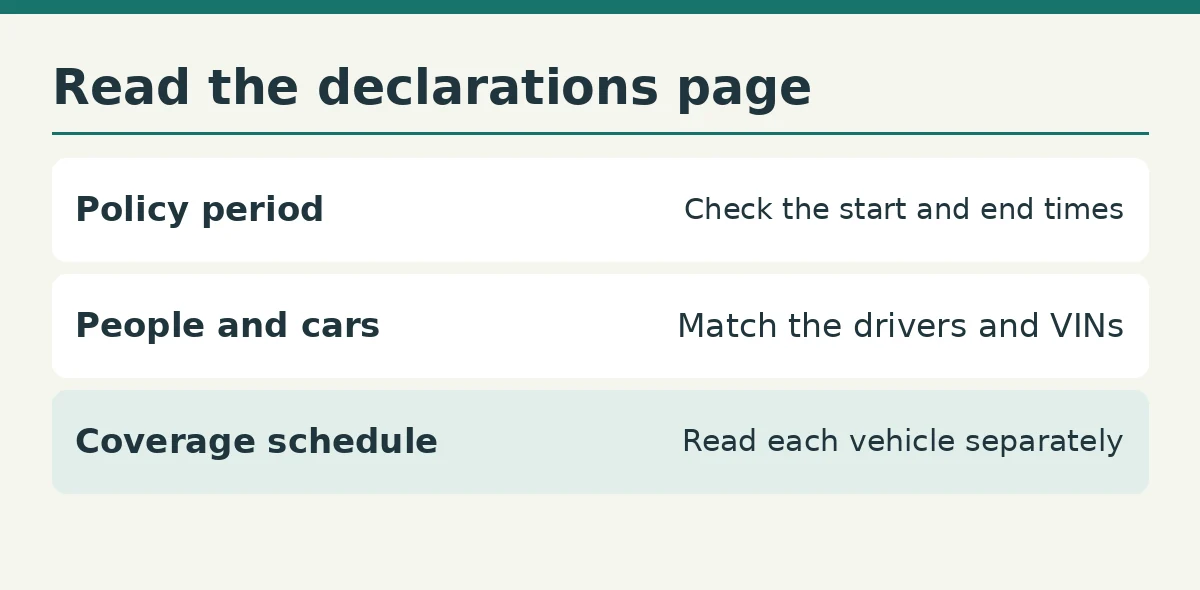
Start with the named insured, mailing address, and policy period. The person shown as the named insured and a household driver listed elsewhere on the policy can have different roles under the contract. Ask the carrier about a spouse, resident relative, or regular driver who seems to be missing from the documents. If a student keeps a car at a different address, check where the insurer records the vehicle as principally garaged. The ZIP code where the bill arrives may be different from the address where the car spends most nights.
Read all 17 characters of the vehicle identification number. Match each vehicle to its own line in the coverage schedule, especially after a trade-in or when you move a plate to a different car. A two-car policy can carry collision on one vehicle and omit it on the other. Compare the start and expiration times as well as the dates when a replacement vehicle or policy is involved. If the document came from a midterm change, check which selections changed and when.
Use auto declarations to request a comparable insurance quote
Copy the basic driver’s list, vehicle identifiers, limits, deductibles, and form numbers from your declarations. Ask the insurer to document any difference in the replacement quote rather than assuming every broad coverage label means the same thing. If you are changing the garaging state, use the Rhode Island moving and car insurance guide to match the date and registration information.
Decode limits and deductibles one line at a time
A row that reads $100,000/$300,000 for bodily injury liability generally refers to the per-person and per-accident limits. Check the separate property damage number. If an insurer uses a combined single limit, ask how it applies to injury and property claims. Use the site’s Rhode Island liability limits guide to identify the state minimum before comparing higher limits. Ask the insurer about protection for claims against you and review your own vehicle coverage on the separate physical damage lines.
Find uninsured and underinsured motorist bodily injury coverage. On a quote, it can be easy to glance at the liability row twice and miss that the uninsured motorist limit is lower. Check the selection shown on the policy and ask for any signed election the company has on file. Uninsured motorist property damage has its own rules and terms. The Rhode Island uninsured motorist guide explains what to check if you also carry collision.
For comprehensive and collision, read the deductible for each coverage on each car. A $250 comprehensive deductible and a $1,000 collision deductible on one car are two separate selections. Make sure that difference was deliberate. If a lender limits the deductible, verify that the policy for the financed vehicle meets the agreement. Ask the company which endorsements apply to each vehicle and whether optional rental reimbursement or roadside assistance has a limit shown elsewhere.
Work through a two-car renewal
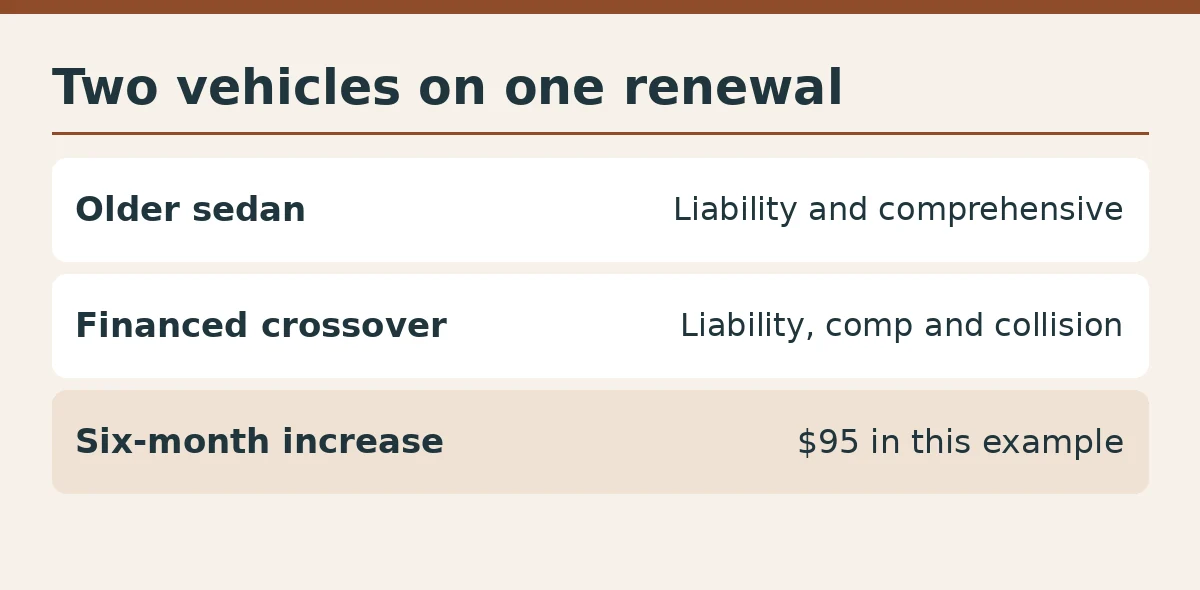
Imagine that a renewal lists an older sedan and a financed crossover. Both have liability coverage. The sedan shows a comprehensive deductible but no collision line. The crossover shows both. The revised premium is $95 higher for the six-month term, and the renewal also lists a different garaging ZIP for the crossover. Compare it with the preceding declarations page before deciding what caused the increase. Ask whether the change came from the address, the vehicle, a discount that ended, or a revised rate applied to the household.
Record what you intended for each car. If the crossover should still be kept at the same address, ask the insurer to check its records and reissue the declarations if there is an error. If you intentionally dropped collision from the sedan, ask whether the resulting uninsured motorist property damage selection matches what you expected. A correction request should name the policy number and the specific car, describe what the document shows, and state what you believe needs to change.
Find the pieces that live outside the summary
Declarations often list forms by number rather than spelling out their terms. Ask for the full form and edition shown on your policy when a listed endorsement affects a decision. Useful examples include a vehicle-use endorsement, a physical damage amendment, and optional transportation coverage. If the insurer says a particular driver is excluded, ask for the document that records the exclusion and when it took effect.
Review the payment notice separately. The policy premium and the actual amount due can differ if the bill includes installment fees, a previous balance, or an adjustment after a vehicle change. If you request a correction, ask how the premium and billing schedule will change. Save the old and revised documents so you can reconcile both figures.
When comparing companies, prepare a copy of the limits and deductibles you want without sharing more personal information than the quote requires. Ask each carrier to use the same vehicles, household information, and effective date. The Warwick auto quote comparison guide shows how to compare term and payment totals. Save the issued declarations and any written corrections together, with the date on which you received the final documents.
When to pull the page again
Reopen your declarations when a driver moves into or out of the household, a car changes its usual location, financing is paid off, or a policy is renewed. Compare the new copy with the previous one. Report a discrepancy while you still have the policy documents and written request in front of you. If you have a claim, use the declarations and endorsements in effect on the date of the loss.
Use the declarations page when you call about a claim
Have your policy number, the loss date, and the correct vehicle row ready. If the adjuster cites a deductible or limit that differs from the one you see, ask which version of the declarations was used. A renewal or midterm change can leave two similar documents in your inbox. Identify the exact date a change took effect and ask for the applicable form. If you bought the policy through an agent, send the same record to the agent and the insurer so both are looking at the same version.
Sources consulted: National Association of Insurance Commissioners, Consumer Auto; Rhode Island Department of Business Regulation, Consumer’s Guide to Auto Insurance.
Use the auto declarations page to match your quotes line by line
Copy the liability limits, drivers, VINs, deductibles, and relevant form numbers from the policy now in force. Compare the same policy term and payment mode. If you are changing states, the Rhode Island auto insurance moving guide explains which date and proof you should verify with the insurer and DMV.