Compare home and auto insurance quotes before switching in Warwick, RI. Check bundle savings, effective dates, lienholder proof, and mortgage escrow.
Switching home and auto insurance in Warwick can lower the household premium, change what you pay after a claim, or both. Begin with a written quote for the coverage you want and a plan for the exact time each policy starts and ends. If you have a mortgage, auto loan, lease, or umbrella policy, check what proof and limits those arrangements require. Verify that the replacement is in force before you cancel the existing coverage.
Compare the full household cost first
Write down the premium, term, billing fees, limits, and deductibles for each policy you already carry. Ask for prices for moving the auto policy only, moving the home policy only, and moving both if those options are available. Check whether keeping one policy will change a multipolicy discount. An auto quote can be lower on its own while the combined cost goes up because the remaining home insurer removes a credit.
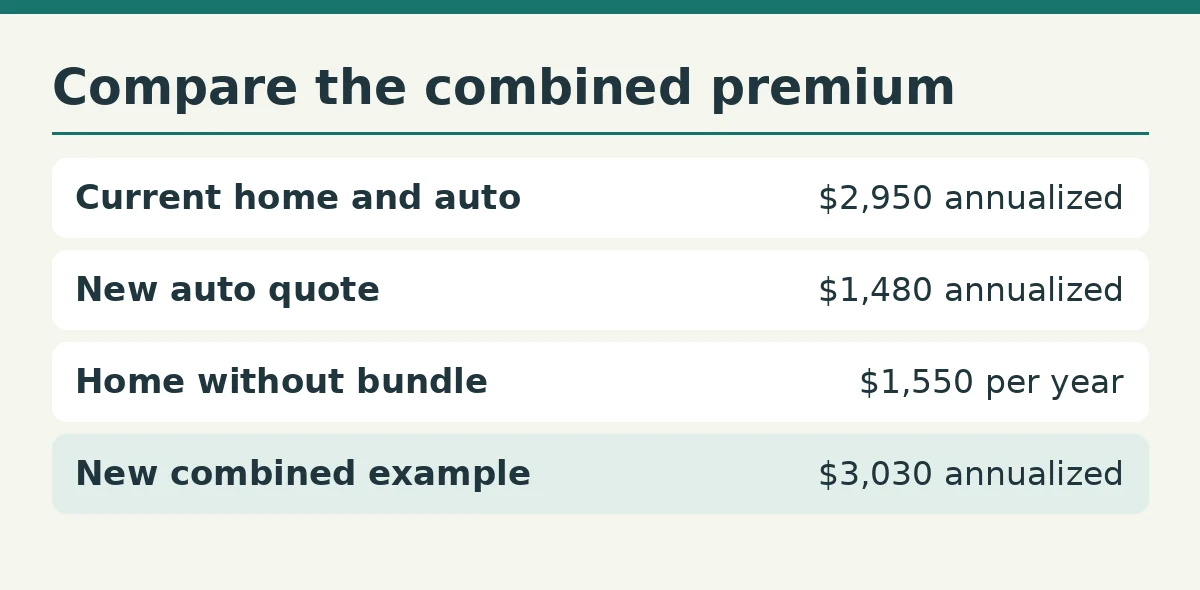
Suppose you currently pay $1,300 per year for home coverage and $1,650 annualized for auto, for a total of $2,950. A competing auto policy would cost $1,480 annualized, but the existing home insurer says the new standalone home premium would be $1,550. The combined price would be $3,030 before other adjustments. If the auto contract is six months, an annualized comparison assumes the price repeats at renewal. Use the Warwick auto insurance quote guide to compare the same term and billing arrangement. Request a separate estimate for the full bundle.
Compare replacement bundle quotes when renewals do not line up
Set the home and auto start dates independently and ask both insurers when the bundle price actually starts. Compare the cost if one policy moves today and the other after renewal. Get the old cancellation date and any refund calculation in writing. If you are moving after a notice from the home insurer, the homeowners nonrenewal checklist can help you plan around the old term’s end.
Compare coverage line by line
Check liability limits, uninsured motorist selections, and each vehicle’s physical damage deductibles. For the home, compare the dwelling limit, standard and hurricane deductibles, roof settlement, and any coverage for water backup or building code costs. An insurer may offer a lower premium using a different dwelling estimate or a different roof endorsement. Ask what assumptions changed. If you already have a separate flood policy, check that policy’s term and billing independently.
Use the homeowners declarations page guide and the auto declarations page guide to compare your issued documents with the quote. Ask the new carrier what it needs before it can bind the policy. If you carry an umbrella, confirm that the replacement policies will satisfy its underlying coverage requirements and that the umbrella insurer receives any required notice.
Coordinate the policy start and cancellation
Ask the new insurer for the effective date and time in writing. Confirm the carrier has accepted payment and any documents it needs before coverage starts. Check the dates on the insurance card or binder and make sure the car or property is correctly listed. Then ask the old carrier how to request cancellation and confirm the date and time it will take effect. Compare the times, especially if the companies use different language or time conventions.
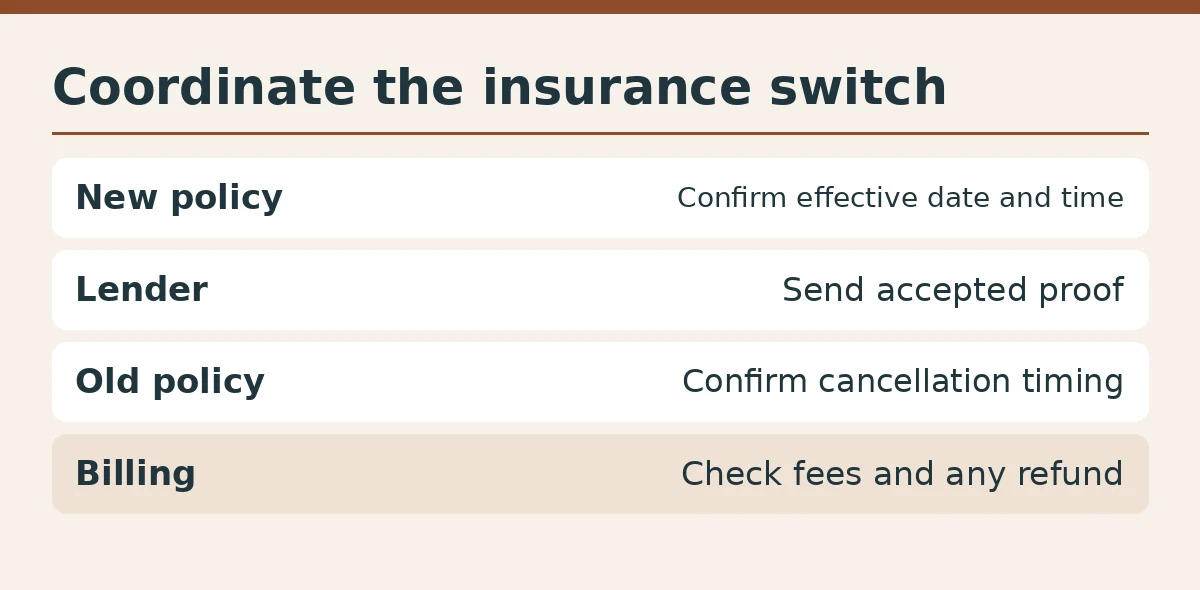
If you are switching before renewal, ask whether the current insurer will refund part of the premium and how it will calculate the amount. Find out whether fees or payment installments affect that figure. Ask for the cancellation confirmation and keep it with the replacement policy. If you change your mind after applying, confirm the status with each insurer rather than assuming an application or payment reversal automatically resolves it.
Notify the lender and confirm how the premium is paid
Send proof of the new home policy to the mortgage company using its instructions. Check the mortgagee details and the policy’s effective date. If the loan uses escrow, ask who will pay the first bill and where any refund from the old insurer will go. If you receive a refund directly after the old policy was paid from escrow, ask the servicer how it should be handled. For a financed or leased car, confirm that the new policy meets the agreement’s coverage and deductible requirements.
If a lender has placed its own coverage because of a documentation issue, ask what proof it needs to review the dates and any related charges. Keep the acknowledgment that it accepted your replacement document. The Warwick homeowners insurance paperwork guide explains how the lender’s insurance requirements and escrow records fit together.
Check the final records after the switch
Review the first bill from the new insurer and the closing statement from the old one. Confirm the policies have the dates, limits, endorsements, and discounts you selected. Update the insurance card you carry and the policy documents your household can access. If an insurer mails a notice that appears to contradict what you agreed, contact the company using your saved confirmation. Keep the old policy for any loss that occurred during its term.
Watch for a change to escrow or billing after the switch
If your old homeowners policy was paid by escrow, the refund may arrive on a different date from the new premium charge. Ask the mortgage servicer how it wants the refund handled and when it expects the new policy bill. Keep the old insurer’s cancellation statement and the new insurer’s receipt. Check the servicer’s records once the payment has posted. If the amount differs from what you expected, ask whether the difference reflects timing, the premium itself, or another escrow item such as taxes.
For the car, check whether the existing insurer will continue an automatic installment after the requested cancellation date. Ask how it handles any final balance or refund. Keep payment records until both companies have issued their final documents. If you have several vehicles, confirm that each one is listed on the intended policy and that you have the matching insurance cards.
Use a written timeline when policies renew on different dates
You can plan a switch even when the home and auto policies renew months apart. List each renewal date, any notice requirements, and the point at which a discount changes. Ask whether the new carrier can give you a written quote for both policies and whether the price will change if one starts later. Compare the cost of moving one policy now with the cost of switching them together. Record any lender paperwork or underwriting step that must happen before either policy can begin. Confirm the final effective dates with both carriers after choosing a timeline.
Sources consulted: National Association of Insurance Commissioners, Consumer Auto and Consumer Homeowners; Consumer Financial Protection Bureau, homeowner’s insurance and escrow guidance; Rhode Island Division of Motor Vehicles, Insurance Verification Program.
Compare bundle savings with the premium you would actually pay
Price switching both policies and moving just one. Ask when a discount changes and compare term totals with matching coverage. For a replacement after a notice from the home insurer, follow the Rhode Island nonrenewal checklist to confirm the old end date and replacement underwriting.