
Compare homeowners insurance quotes after nonrenewal in Rhode Island. Check the replacement policy’s start date, roof terms, and proof for the lender.
Check that your Warwick notice matches your policy, property, and named insured. A nonrenewal at the end of the term differs from midterm cancellation or an offer with changed terms. Ask for the written reason, verify when the old coverage ends, and find out what proof the mortgage servicer accepts. If you question the notice, keep working on replacement coverage while the carrier reviews it.
Read a Rhode Island homeowners insurance nonrenewal notice
Match the address, named insured, policy number, and dates. Ask the insurer to explain any reason that is unclear and which records it used. If the notice refers to condition or repairs, ask what documentation it will review. A quote with another company does not confirm that you are insured after the existing term ends. Request the date on which replacement insurance would be in force after any inspection or payment conditions are satisfied.
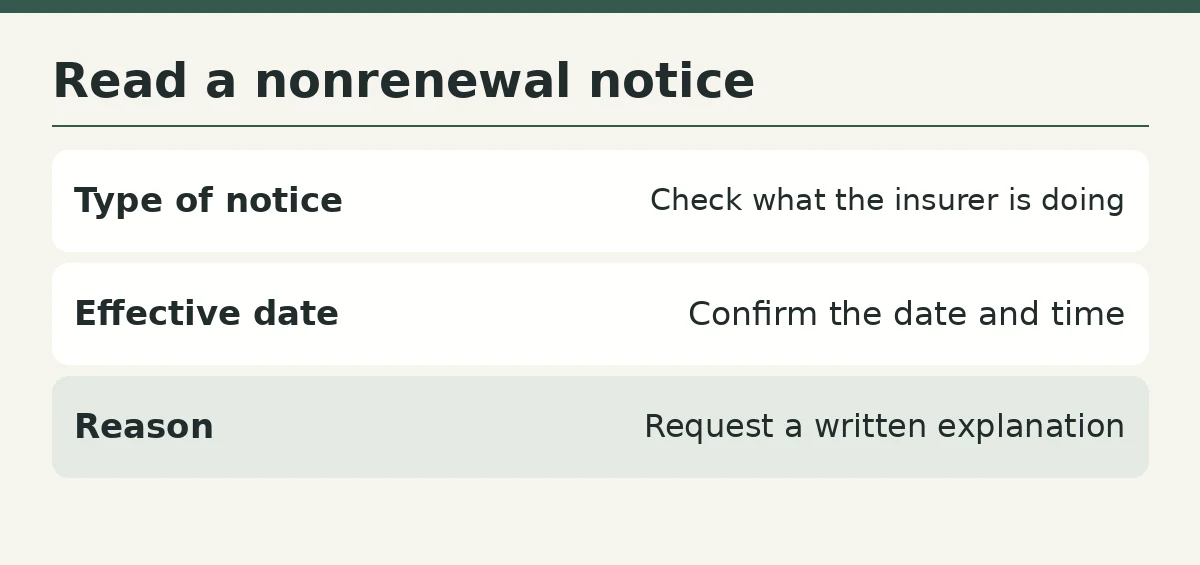
Rhode Island has rules governing notice and, in certain circumstances, property insurers’ nonrenewal practices. Confirm which provisions apply to your policy and the facts. The Rhode Island Department of Business Regulation’s Insurance Division provides consumer information and complaint procedures. Ask the Division what it can review if you believe the notice or its reason is incorrect. Follow the stated deadlines rather than assuming a request for review extends coverage.
Compare replacement homeowners quotes against the nonrenewing policy
Put the prior and proposed policies on one sheet. Record their roof settlement basis, dwelling limit, wind deductible in dollars, and each insurer’s repair documentation requirements. Ask whether the quote remains valid after an inspection and confirm the earliest effective date. If backup protection would change, use the Warwick water backup endorsement guide to price that difference separately.
Get replacement homeowners insurance quotes with current property details
Gather the current declarations, roof age and materials, dates of repairs, property use, photographs or invoices where relevant, and any inspection or notice. Give the same description to new carriers. If you replaced a roof, locate the invoice and date rather than relying on the year shown in an old listing. If the home is unoccupied, rented, or under construction, disclose it. The Warwick vacancy guide explains why dates and occupancy terms need particular attention.
Ask for written offers with comparable limits. Review the standard deductible, hurricane deductible, dwelling estimate, roof valuation, and property endorsements. If a quote has actual cash value roof terms, check how those affect a claim. The homeowners declarations page guide shows which rows to compare when the proposed policy is delivered.
Compare the price and proof on the same timeline
Suppose the old policy ends July 1 and an agent offers a new rate on June 20 subject to inspection. Ask when the inspection can occur and what document confirms coverage by July 1. Verify the effective date and time with the insurer. If the home has a mortgage, confirm the mortgage company will accept the insurer and proof. An accepted application may still leave questions about whether the policy was issued. Save the binder or other evidence the lender accepts.
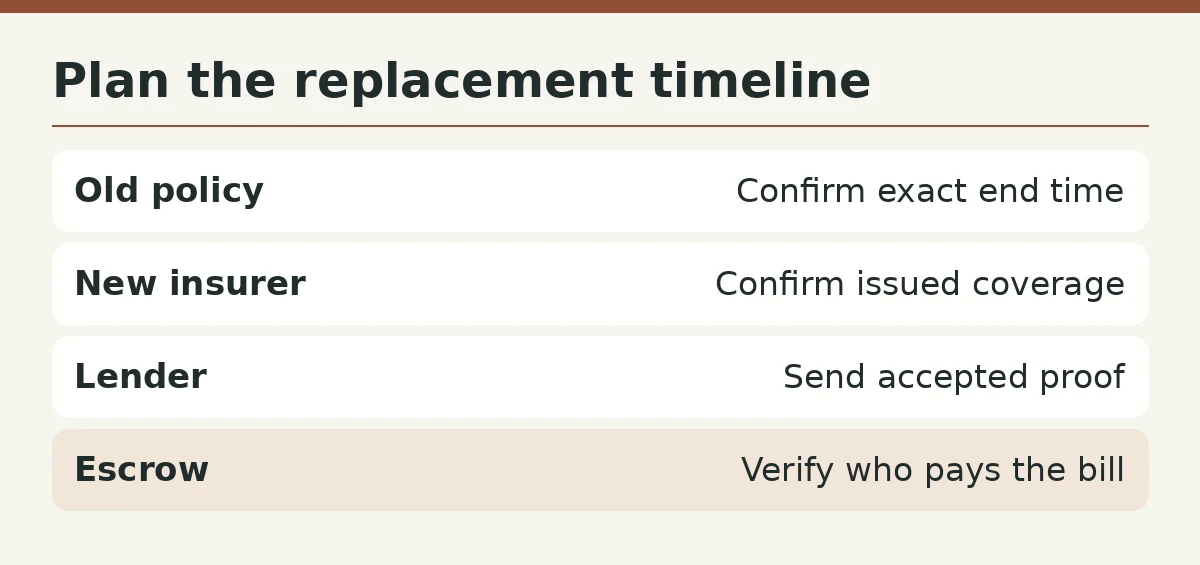
If the property is harder to insure, ask licensed agents and the state consumer resources about available options and how to document them. Ask which losses and limits each offered policy addresses. If a separate flood policy is involved, check its dates and proof separately. Review the home insurance proof and escrow guide for the documents a lender may request.
Update mortgage escrow and compare any home and auto bundle change
Check who will pay the premium if coverage is billed through escrow. Send the updated invoice and proof to the servicer using its instructions. Ask whether refunds for the old policy come to you or back to escrow, and verify the actual record when payments post. If the old homeowners policy was bundled with auto, ask whether the carrier will adjust the auto premium. Compare the total household cost after any discount change.
Document a disputed notice without losing track of dates
If a company’s inspection contains an error, identify the specific fact and submit supporting documentation. Ask whether it will reconsider and when you should expect a response. Keep the documents in date order. If you send a question to the state, identify the policy, letter, insurer response, and exact action you want reviewed. Use the Rhode Island insurance review guide for organizing correspondence, while recognizing that a nonrenewal and a claim dispute are different decisions. Continue confirming the replacement independently.
Once the new policy arrives, confirm the limit, mortgagee, payment, dates, and any inspection condition. Give the lender the accepted proof and keep the response. Retain the earlier contract for any question about an event before the new policy began. The record should clearly show which policy was in force on each side of the change.
Compare roof insurance terms after a nonrenewal notice
Imagine the letter mentions roof condition and the homeowner thinks the carrier used a date from before a replacement. Request the record the insurer relied on. Locate the invoice, permit information if available, and dates. Send only the relevant documents and ask whether it will reconsider. Keep the notice deadline on your calendar while the review continues. Obtain replacement quotes using the correct roof details and ask what inspection the new carrier needs.
A new carrier could offer coverage with an actual cash value roof endorsement or different deductible. Ask for the form and an explanation of how a covered claim would work. The Warwick roof settlement guide explains the distinction. Compare the total premium with possible claim expenses and lender requirements. Ask whether any initial proof remains subject to a later inspection or change in terms.
Compare a conditional offer with the documents your lender accepts
Suppose you have a quote for $1,680 but the insurer says it needs a review before issuing. A second carrier can send evidence now for $1,785 subject to the terms shown. Ask the first carrier for a realistic timeline, ask the second for its written terms, and verify which document is acceptable to the lender. Compare the same dwelling and deductible amounts. A cheaper application does not establish a policy or its effective date. Set a reminder before the old term ends to confirm what is actually in force.
If the property also has flood insurance, verify whether the lender needs separate evidence and keep the dates apart. Ask about the mortgagee name, servicing address, and payment responsibility. Send confirmation once the carrier issues the policy. If you pay directly and the account uses escrow, ask the servicer how it wants the receipt recorded so payments are not duplicated.
Keep the review trail through the next renewal
Store the notice, previous contract, correct insurance proof, lender confirmation, and written explanations. If the carrier corrects a fact or replaces the offer, record which document you accepted and when. If an insurer declines to cover the property on terms that fit your needs, ask which information would affect a new quote. Review whether the old insurer charges for the remainder of a term or whether the nonrenewal simply takes effect at expiration.
Check the new declarations and subsequent bill for the agreed amount, premium, and endorsements. Follow any requirements the carrier identifies for the condition of the property. Confirm how it will notify you about changes. At the next renewal, ask for a new comparison using the current roof, work, and occupancy information. Keep the old coverage record if a loss occurred during its term.
Check whether the notice is a cancellation, nonrenewal, or changed renewal
Read the document’s stated action and compare it with the policy expiration. A new quote at renewal can show a higher deductible or different settlement method, whereas a nonrenewal says the insurer is ending coverage at expiration subject to the rules that apply. If the notice says coverage will stop earlier, ask why and which provision the company is using. Get its actual explanation and verify the date before acting on an assumption.
If a letter appears to use an old address or incorrect roof information, request the correct record and send proof. Ask the insurer whether that changes the notice and obtain the answer in writing. Review the state’s consumer information if the explanation is unclear. Continue tracking coverage while a correction is pending. An informal message does not establish a new expiration date or an extension.
Present the same information to each replacement insurer
Send a concise packet with the home description, roof date, occupancy, mortgagee, prior declarations, and relevant repair records. Tell each carrier the exact date you need coverage. If the company offers a different property policy, check whether it matches the building’s use and the lender’s requirements. Ask what endorsements it includes or omits, and whether its offer relies on a future inspection. A premium quote should be compared with the policy the company is actually able to issue.
Run one loss example on both quotes. Suppose the house has a covered roof claim and one carrier uses replacement cost while the other uses a schedule. Ask what deductible would apply and which valuation method determines the eligible amount. Check any separate limitations connected to the condition that prompted the notice. If more than one part of the policy differs, record the differences before deciding which proof to send to the lender.
Keep the mortgage and billing timeline tied to the issued policy
Send evidence and the invoice when requested, and ask if the mortgage servicer has accepted them. Verify which party pays the first bill. If insurance is paid through escrow, check the actual disbursement after it posts. If you already paid directly, send the receipt through the servicer’s approved process. Ask how an older refund should be handled. If you receive a letter about lender-arranged coverage, reply through the specified process with proof for the relevant dates.
Check whether moving the home policy changes another bill, such as the auto premium in a bundle. Ask what changes would occur at once and what applies at the next renewal. Use the Warwick home and auto insurance switch guide to plan dates while reviewing the new cost. If the cheaper quote leaves more of a potential loss for you to pay, review that effect separately.
Set a final confirmation date ahead of expiration
Choose a date before the old policy expires to obtain written confirmation from the new insurer. Check the address, coverage start, and any outstanding requirements. Ask the lender to confirm receipt if it needs proof. Keep the old notice and policy accessible until billing is reconciled. If a claim arises from the prior term, the old policy still provides the relevant record to review for that date.
Ask how to document a prior repair during underwriting
For work involving a roof, electrical service, or another major system, make a short list of what was done and when. Locate the invoice or inspection report if available. Give each carrier the same facts. If a policy is issued subject to a later inspection, ask what dates and conditions apply and how the insurer will tell you about any change. Keep the evidence accepted by the lender in a separate place from materials still under review. If a replacement carrier changes the deductible after reviewing the house, obtain the revised terms and confirm whether the lender needs updated proof.
During the comparison, record whether each policy has a separate roof schedule, a higher percentage deductible, or a shorter period of temporary living expense coverage. Ask what you would retain as a cost after one realistic loss. Confirm priorities before selecting the premium. Check the first full bill and set a reminder for any condition the insurer must review.
What to compare before replacement homeowners coverage starts
Request the same property limits and deductibles. Give carriers updated roof age, occupancy, and repair records. Compare Coverage A, roof settlement, hurricane deductibles, and any exclusions.
Confirm whether you have a quote or issued coverage. Ask about inspections, payment, and proof of the exact effective time. If you have a mortgage, confirm what evidence the servicer accepts.
Compare the full household cost. Check who pays the first premium, verify the escrow record, and ask if switching the home policy changes any auto bundle discount. Have the replacement confirmed before the previous policy ends.
When a replacement carrier asks about the nonrenewal, give it the notice and any requested scope of completed repairs. The Warwick Allstate homeowners coverage checklist lists the dwelling limits, deductible amounts, and settlement details to match on the new quote.
Sources consulted
Rhode Island Department of Business Regulation, A Consumer’s Guide to Home Insurance; Rhode Island General Laws § 27-29-17.2 and 230-RICR-20-05-13.