Compare builders risk insurance quotes for a Warwick home renovation. Check where materials are covered, when the policy ends, and the project limits.
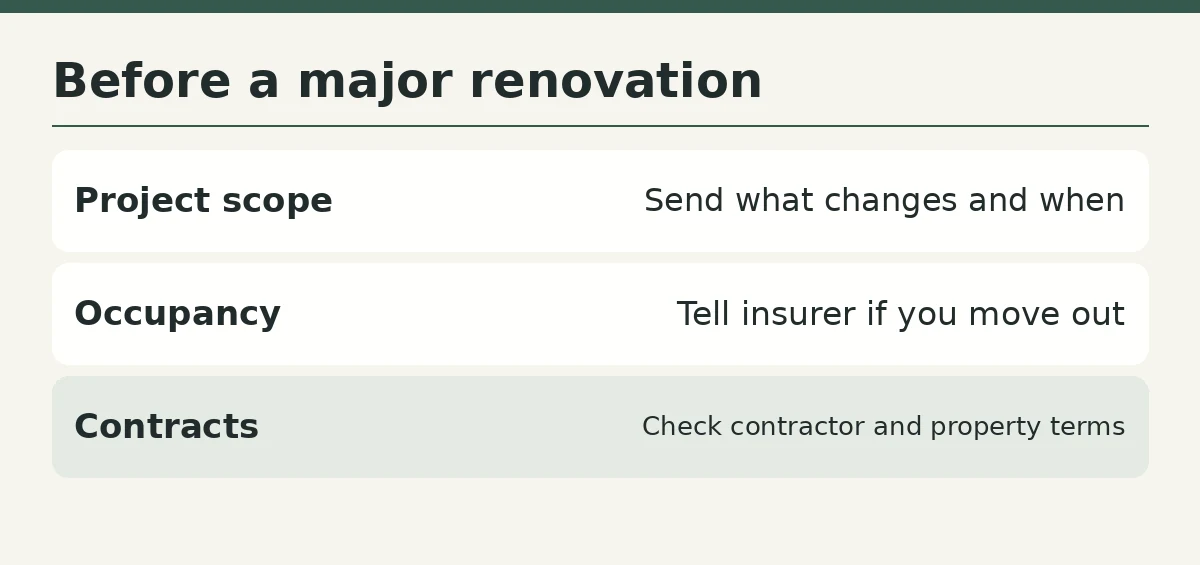
Tell your homeowners insurer what will change, when work starts, where materials will be stored, and whether you will move out. Ask whether a renovation endorsement or a separate builders risk quote addresses the project. Verify the contractor’s insurance independently, including who and what it covers. Have the written terms ready before delivery or demolition.
What insurers need for a home renovation insurance quote
Tell the carrier what will be removed, what will be built, when work starts, and how long it should take. Describe whether plumbing or wiring will change, whether rooms will be opened to the weather, and when you expect to live elsewhere. Supply the project scope or permit information if requested. Ask how the carrier classifies the property during the work and whether the dwelling limit remains appropriate.
If you plan to stay elsewhere, share the dates and use the vacancy guide to identify wording to ask about. A home temporarily without residents and a construction project can raise separate questions on one policy. Ask about a delayed return and which insurer or broker you should contact if the schedule changes. Keep the written terms next to the contractor’s timeline.
Check which policy covers the renovation work and materials
Ask each builders risk provider to identify the insured structure, project materials, deductible, and time coverage would end. Discuss who pays if supplied materials are damaged before installation. Have the contractor separately describe its liability coverage and who carries it. The Rhode Island contractor liability comparison explains what to verify in the contractor’s insurance documents.
Compare builders risk coverage for existing property and new work
Builders risk commonly refers to property coverage for construction under defined terms. Ask the proposed carrier which work and materials are insured, whether it includes an existing structure, and where materials must be located. Ask about theft, water, and other specified causes, and when the coverage begins and ends. The answer can differ for materials stored at the property, at a supplier, or in transit. A person’s belief that items are insured by the contractor does not establish coverage.
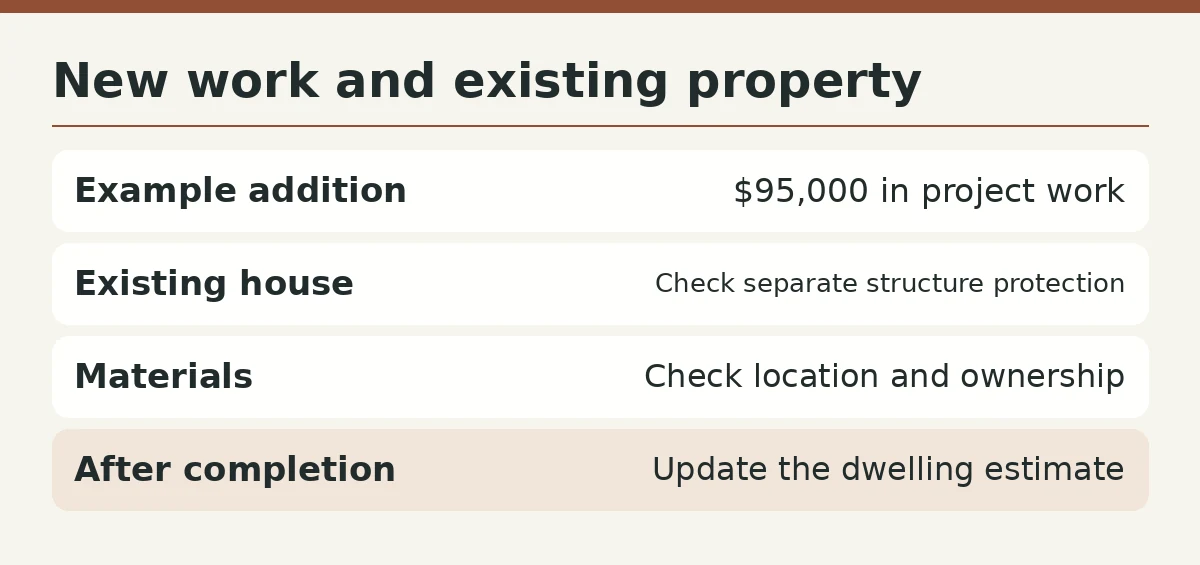
For example, a kitchen addition could cost $95,000 while the existing house has a much larger rebuilding estimate. Ask whether a project policy would insure the extra work, the existing building, or both, and whether the homeowners carrier continues to cover the house during work. Ask what happens if a fire damages both old and new areas. Compare separate limits, deductibles, and responsibilities before you pay for an endorsement or project policy.
Check contractor liability and workers’ compensation proof
Ask which entities will perform the work and obtain the proof your agreement or adviser requests. A contractor’s general liability and workers’ compensation answer different questions from property coverage for the project. Certificates are useful but may not describe all endorsements or exclusions. Check dates and names and ask an appropriate insurance professional to explain what proof is sufficient. If a subcontractor is involved, ask how your agreement handles the subcontractor and which party confirms insurance.
Discuss how damaged material and work will be handled. Keep invoices, photographs, and the documents that identify who purchased equipment or owns it during installation. Read what your insurer wants after a loss and what the contractor must document. If another company is supposed to insure materials before delivery, confirm the arrangement and date of transfer.
Update the house after completion
Once work is done, ask when builder coverage ends and when homeowners limits should change. Send a description of the addition and any new features to the insurer. Use the home replacement cost guide to check the new square footage and rebuilding assumptions. A contractor’s project price is useful information, while the insurer’s rebuilding estimate covers a different scope.
Keep before-and-after photos and records of new furniture or electronics. The Warwick home inventory checklist can help record items added. Ask the lender whether it needs revised evidence. Confirm the final policy and retain the coverage documents for the construction period in case a question arises about when particular damage occurred.
Compare a small job with a renovation that opens the house
Consider a week of replacing appliances, flooring, and cabinets in an occupied kitchen. Compare it with a six-month addition that opens an exterior wall and leaves the home temporarily empty. Tell the carrier which facts apply and when the work changes. Ask whether a homeowner endorsement, a project policy, or another arrangement needs to be considered. Find the written conditions before assuming the old policy describes the home during construction.
In the addition example, ask which insurer would address damage to the old house and which would review the new framing. If the same storm affects both, request an explanation of how the contracts coordinate. Check materials storage, transit, and installation separately. Give the company the dollar amounts and intended location of major items. Ask what happens if the contractor’s schedule changes and materials stay on site longer than expected.
Track the cost as the project changes
Suppose the contractor estimates $95,000 and a later change order adds $18,000. Ask which insurer needs notice and whether a different limit should be considered. The building work may now be $113,000, but property value and insurance terms depend on which part of the structure is covered. Ask whether materials bought directly by the homeowner count, how they should be documented, and whether any equipment has its own condition. Save written approvals and invoices.
If you need to restore the home after a separate covered loss during the renovation, ask which estimate applies to existing damage and which represents planned work. Keep those two scopes distinct. Use the Warwick code coverage guide if required work after a covered loss raises a separate expense. Ask the insurer whether it needs a written notice of the code requirement. A design upgrade and a change required by code may involve different coverage questions.
Plan proof, site changes, and the transition back to ordinary coverage
Ask whether the project contract requires a specific certificate, insured name, or proof from a subcontractor. Record who collects it and whose policy it describes. If several companies work at different times, keep their documents by date. Review the expiration of the project policy against the construction schedule and ask the insurer which event ends coverage. A final inspection, acceptance, occupancy, or completion can be distinct events depending on the form.
When the home is ready, tell the homeowners insurer its updated features and date of occupancy. Check rebuilding value and the mortgagee listed on the new policy. Keep the project coverage record for any loss that occurred earlier. Store construction photos and receipts in a way that distinguishes permanent improvements from belongings. Add new items to the home inventory so the rebuilt home and contents are evaluated using current information.
Ask who bears a loss before a material is installed
Suppose a supplier delivers $15,000 of cabinets and appliances three weeks before they are installed. Find out who owns them once they arrive, where they will be stored, and which policy, if any, covers them there. Ask how the answer would differ if they were held at the contractor’s storage space or being transported. Get confirmation in writing and keep proof of purchase and delivery. A homeowners policy, contractor policy, and builders risk agreement can use different descriptions of insured property.
If the materials are damaged, ask the appropriate insurer whether it needs photographs, invoices, tracking records, or a contractor report. Identify whether the loss is to purchased materials, partially installed work, or an existing surface. Ask whether a deductible or other limit applies. Do not assume assigning an expense in the construction contract establishes insurance coverage. Keep the agreement and policy records so you can identify how ownership and insured status were documented.
Check builders risk policy expiration, occupancy, and extensions
A project expected to finish in October can run into November. Ask the carrier which events could end coverage: a calendar date, occupancy, acceptance, or completion as defined by the form. If the schedule changes, ask what an extension requires and when it must be arranged. Tell the homeowners insurer as well, particularly if the property remains unoccupied or open to the weather for longer than expected. Ask where its changes appear on the issued documents and verify the dates.
Check whether the contractor contract describes who must purchase an extension. A project manager may update scheduling records faster than insurance records. Write down which person is responsible for each communication. If the homeowner moves back before all work is complete, tell both insurers and ask what happens to the existing and project insurance. Get the transition documented so a loss during the last weeks of the job can be reviewed under the right forms.
Test a claim that involves old and new work
Assume a covered event damages part of the existing kitchen and a new addition that is still unfinished. Ask the carrier or adviser which insurance would be reviewed for each part, and whether the policies include coordination or separate deductibles. Have the contractor separate work stemming from the event from the originally planned work. Save a version of the scope before the loss and the revised version after it. If an insurer wants a written explanation of why a line was added, ask the contractor to describe it.
Check how you would document living expenses if the project or insured damage keeps you out of the home. Use the APK guide to loss of use and additional living expenses to identify what a covered loss might require. Expenses from a planned move during construction have a different cause from displacement after damage. Ask the insurer which facts it needs to separate the two.
Set a final coverage check after the project
Send the completion date and updated layout to the homeowners carrier. Check the dwelling amount, endorsements, and photos or inspection it requested. Ask the lender whether updated proof is needed. Retain the construction policy and proof that you reported occupancy or completion. The new policy protects the property described on that document. Check that any contemplated detached structure, upgraded finish, or material still kept outside is treated as you intended.
Check whether a contractor change also changes the insurance record
If the original contractor leaves the project, have the replacement describe what work it will take over and when. Obtain the proof your agreement requires and give the insurer the changed schedule. Ask whether material storage, control of the site, or the temporary occupancy arrangement changes as a result. Identify who will need to submit the new documents and check when any prior coverage ends. An initial policy may have been written for a particular owner, contractor or schedule. Ask whose name belongs on the coverage as the job changes and whether any new form is needed.
Compare premiums after you know which part of the project is insured
A project policy with a lower premium could be written for new construction only. A competing offer might consider parts of the existing house. Compare the insured property, causes of loss, deductibles, duration, and lender proof using the same project. Get a written summary of which policy covers each item. Ask how the company would handle a change order and whether any coverage is limited when work is paused for several weeks. Set the comparison next to your construction budget so you can see which expenses you would retain if a loss affects both old and new sections.
Ask the insurer what happens if the renovation introduces equipment or materials it did not price originally. Update the project scope as soon as the change is agreed and ask for the new limit in writing. Record which quote or policy version shows the addition.
Use the same project scope for each builders risk quote
Identify each part of the property. Ask what insures the existing house, work in progress, and materials before and after installation. Give the insurer the locations for materials stored off-site or moved in transit.
Price the real project timeline. Confirm the planned start, occupancy changes, and events that end coverage. Ask how you would extend the term if a permit or contractor delays completion.
Compare deductible, limits, and proof. Request the form the company would issue, check the contractor’s proof separately, and ask which insurer accepts changes to the cost or scope.
If plumbing will be disconnected during renovation, describe the timing and protection of exposed lines. Compare a water backup endorsement on the completed home separately from the project policy’s terms for water damage during construction.
Sources consulted
Insurance Information Institute, remodeling and homeowners insurance guidance; National Association of Insurance Commissioners, Consumer Homeowners.