
Compare usage-based car insurance quotes in Warwick, RI. Check pay-per-mile rates, driving data, and what you might pay after the enrollment discount.
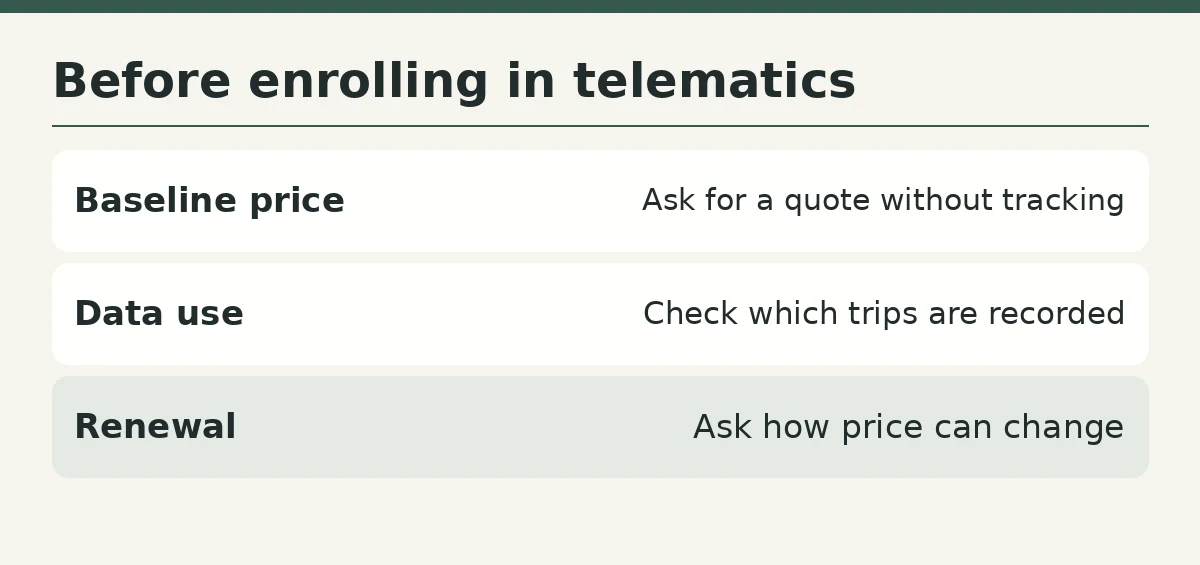
Ask for a fixed-rate quote with the same drivers and limits before enrolling in telematics. Then find out whether the program charges per mile, tracks driving behavior, or uses both. Compare mileage in a typical month and a high-mileage month, and check what happens when the enrollment discount ends.
Pay-per-mile car insurance versus a driving behavior discount
A telematics program may measure mileage or driving behavior. A per-mile plan may have a base charge plus a rate for measured miles. A monitoring program can offer an initial discount and later use data for renewal terms. Ask for the written description and confirm whether the program can raise the price, reduce it, or only remove a credit. Keep the coverage and billing period the same when comparing the version with and without it.
Request a pay-per-mile quote in a high-mileage year
Ask for annual cost estimates at the mileage you expect and at a plausible higher amount, such as after an office move. Keep all limits the same and ask whether the price uses mileage alone or a separate driving behavior score. Compare it with a conventional policy using the Warwick car insurance quote guide and verify fees that apply after the introductory term.
Calculate pay-per-mile car insurance costs at different mileage levels
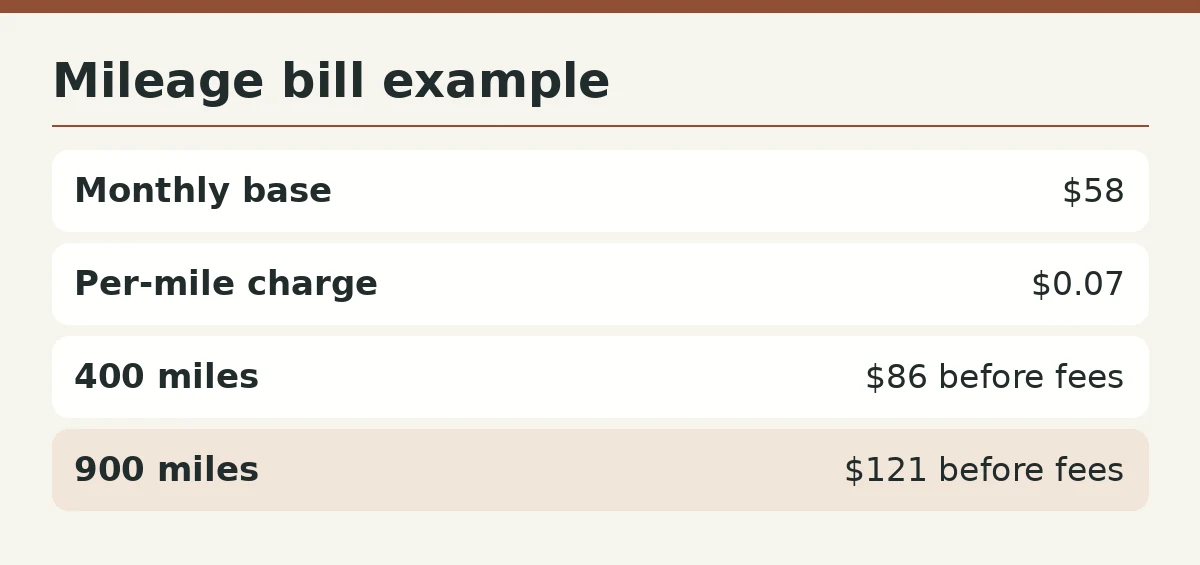
Suppose an illustrative per-mile quote charges a $58 monthly base plus $0.07 per mile. At 400 miles it costs $86 before any separate fees. At 900 miles it costs $121. Compared with a $105 fixed quote on otherwise comparable terms, the first month would be $19 cheaper and the second $16 more expensive. Ask whether the form caps billable miles on particular trips, how it handles missing data, and what changes at renewal. Use your actual mileage rather than the shortest month you remember.
If you drive fewer miles now because you work remotely, check what the price would be after an office schedule changes. For a car driven mainly on weekends, include longer trips and holidays. If two cars share a policy, find out whether each can use a different pricing approach. The Warwick car insurance quote comparison explains how to align limits and fees before comparing totals.
Find out what data the program uses
Read which information is collected, whether the device or phone tracks location or driving events, how data is used, and what choices you have. Ask which information is required and who has access under the program terms. If the app tracks trips automatically, ask how to correct one where you were a passenger or another person had your phone. Check the correction and dispute procedures. Review the retention and withdrawal terms while you have access to the current agreement.
Ask how the program detects a trip if the phone is shared or the car has several drivers. Confirm whether all drivers need to enroll and who can see the records. For a teen driver, use the Warwick teen driver insurance guide to separate the driver and vehicle changes from a program discount. If a driver leaves home or takes a car to school, update the insurer before assuming the same program remains appropriate.
How telematics discounts can affect your car insurance renewal
Compare the first premium, the price without an enrollment credit, and how performance or mileage is reflected. Ask how long enrollment lasts and whether the carrier uses trips from a fixed period or continues collecting them. Ask whether withdrawing early affects the current term and which rate will apply afterward. A carrier may change the overall policy rate at renewal even if a program credit stays the same. Ask to see the items separately.
Use the Allstate discounts overview for examples of questions to ask one carrier. Ask which terms are approved for the policy you are actually buying. Compare the documented renewal offer with a fresh offer from another insurer if the result changes the household budget. Keep the term-and-fee worksheet so you can separate a program effect from a rate change or altered coverage.
Check your decision against the first bill
Compare the bill with the written base price and what was recorded. If the total differs, identify whether it came from paid miles, an installment fee, a missing credit, or a changed address. Ask the carrier to correct inaccurate information and confirm how any dispute should be handled. Keep a record of your own mileage and program communication. Revisit the plan when your commute, vehicle, or household changes. The best fit depends on how you actually drive and what the carrier charges for that pattern.
Compare a fixed price with a year of mileage
Suppose the household has eight months around 400 miles and four around 900 miles. With the article’s illustrative $58 base and $0.07 per mile, those months would cost $688 and $484, or $1,172 for the year before other charges. The fixed $105 example would cost $1,260 over 12 months if that price held. Ask what changes if the carrier updates a base rate or starts a new term before the year ends. Use the actual plan’s rules to calculate billable miles. A year of mixed driving can show a different result from a single month.
If you expect to start driving more, test a second scenario, such as commuting again or taking several longer trips. Ask if the insurer uses mileage only or also factors other trip information into the price. Request the exact range of possible charges or discounts the plan describes. Use the same drivers, deductibles, limits, and payment terms on the fixed and variable policies. Put any changes you cannot align in the comparison notes.
Review which household members are enrolled
Tell the insurer if a teen and adult share a vehicle or the family uses one phone for different trips. Ask how the company attributes a trip or handles an incorrect label. If the program requires every driver to enroll, ask what happens when a driver does not use the device or withdraws. Ask which changes would affect credit or billing and when those changes apply. Read the privacy terms before any household member starts recording trips.
If you rent or borrow a vehicle, ask whether an app will collect information or assign the trip to your policy. If you are riding as a passenger on the regular commute, ask how to correct that trip and whether it counts against you before correction. Get the procedure in writing. Save a dated record if you dispute a trip or price. A confirmed correction should appear in the appropriate program record.
Check after the enrollment period as well as after the first bill
If the quote includes an introductory credit, write down its amount and the date it ends. Ask whether the company replaces it with a score-based discount or recalculates the premium on another basis. Check whether the baseline rate changed around the same time. Use written bills and policy dates to separate the factors. If you decide to exit, request the terms and what amount is due for the remaining term.
Ask how the program will work after a move or vehicle replacement. A garaging update and changed commute may affect the baseline and program price. Give the insurer current facts and get another quote if needed. Check the Rhode Island auto declarations page guide after changing coverage. Verify the issued policy and other costs separately from the program’s summary.
Review a discount that changes between terms
Suppose the carrier offers a $48 enrollment discount for the first six months. Ask whether it replaces that amount with a different credit at renewal or uses another rate. A renewal bill can rise because the introductory credit ended and the baseline price changed. Ask the carrier to show the components separately. Compare the new total with an offer for the same vehicles and limits without a program. Check if a different billing fee or payment mode changed at the same time.
If the program asks you to report an unusual trip, verify the procedure and correction deadline. Ask what the app does when you take public transportation, are a passenger, or travel with the phone off. Some plans measure miles with a vehicle device, while some phone programs classify trips and driving events. Ask how the provider resolves uncertainty. Keep documentation of a correction and check how it affected the record.
Compare the fit for a commuter and a seasonal driver
A person who drives the same commute each week may be able to estimate mileage from recent months. Someone who uses a car for seasonal work might have several months much higher. Ask for a year of estimated costs under the actual plan. If a carrier measures driving behavior as well as miles, find out which events affect price and what period the company uses. Describe the actual use of the car rather than trying to model every trip from a single average.
Review whether a second vehicle shares the same program and which price is associated with each one. If a student drives one car during breaks, ask whose phone or device records trips and what happens when the driver moves. Ask whether participation is mandatory across the policy or can be chosen vehicle by vehicle. Put the expected price after any introductory incentive next to the untracked quote.
Check driving app data, trip corrections, and billing terms
Find out who provides the app or device and what information it collects and retains. Ask what happens to existing data if you withdraw, and what controls are available. Check whether other household members must agree to the terms. If multiple drivers share a car, discuss privacy choices before anyone enrolls. An enrollment credit is a price feature. It is useful to evaluate it alongside the records the household agrees to share.
If a trip is recorded incorrectly, use the carrier’s correction process and store the written acknowledgment. If the issue changes the bill, ask which line was affected and how the corrected price is calculated. Review the first and renewal statements. If you decide the plan no longer fits, compare the price and coverage after withdrawal with a fixed quote and check whether a fee or discount change applies.
Decide how often to refresh the comparison
Use recent mileage, a realistic change to the commute, and the household’s preferred billing method. Revisit the worksheet after a new job, move, or driver change. Confirm the company’s current program rules and the exact amount you will pay in the next term. If you keep the program, record the date at which any introductory terms or a review period end.
Compare a per-mile plan near its break-even point
In the $58 plus $0.07 example, a $105 fixed monthly premium differs from the base by $47. Dividing $47 by seven cents gives roughly 671 miles before fees. Ask the carrier what mileage is billed and whether a monthly fee would change that comparison. Then compare several months below and above the point. This computation applies only to the illustrative prices. A program that scores driving behaviors rather than charging by mile needs a different comparison. Ask for the terms and how a score can change the price at renewal before using a spreadsheet to estimate it.
If you keep an odometer record, write down the date and the vehicle it belongs to. Compare your records with the period shown on the bill. A change of vehicle, device or account can affect what is recorded. Ask how to handle the transition and when the new device begins logging miles. Verify the final amount after any billing correction.
Compare the quote before turning on telematics
Build a fixed-price baseline. Use the same liability limits, physical damage deductibles, drivers, fees, and payment schedule. Ask for the term total with and without the program.
Price both driving patterns. For per-mile insurance, ask about the monthly base rate and billable miles. For a score-based discount, ask whether a low score can raise the price or reduce a credit.
Check enrollment and renewal conditions. Find out how trips and drivers are assigned, how errors are corrected, and whether the carrier retains data after withdrawal. Request the quote that would apply once any introductory credit ends.
When you compare an insurer’s standard plan and monitored rate, keep its age, mileage, and garaging assumptions consistent across both options. The Warwick Allstate auto rate checklist shows how to compare the same billing term and verify discounts.
Sources consulted
National Association of Insurance Commissioners, Telematics and Understanding Usage-Based Insurance consumer guidance.