Compare car insurance quotes in Warwick, RI using the same drivers, limits, deductibles, and policy term. Check fees and home and auto bundle savings.
Two car insurance quotes for the same Warwick address can differ because the carriers priced different policies. One may show a six-month premium with a $1,000 collision deductible. The other may show an annual premium with a $500 deductible and rental reimbursement. Before choosing, ask each company to quote one set of coverage and show the full cost for the same term. Rhode Island’s consumer guide to auto insurance explains why an initial quote can change as the insurer confirms your information.
Send each insurer the same quote request
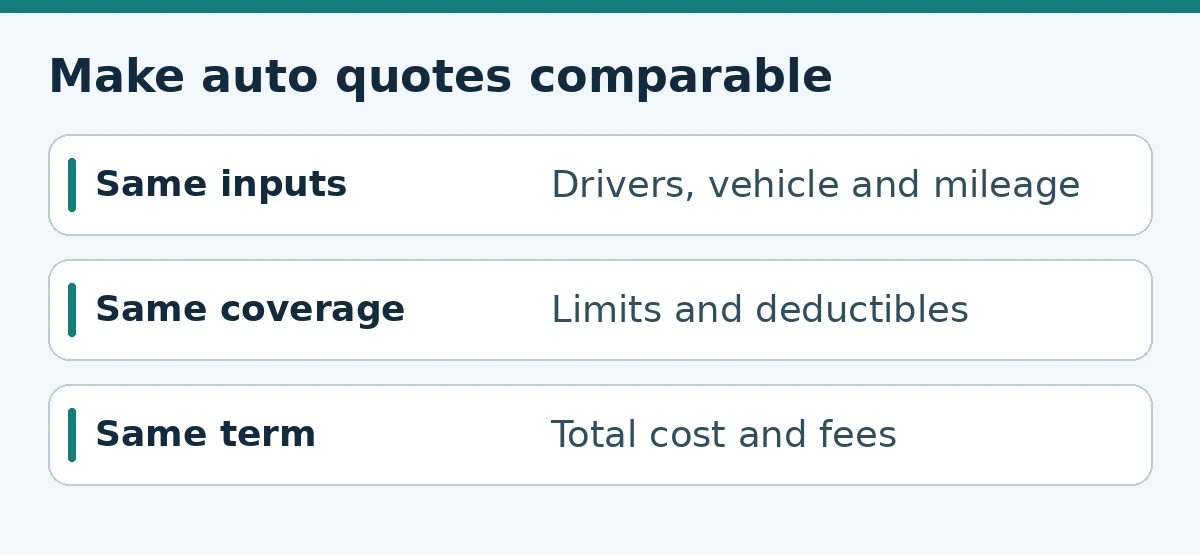
Copy the vehicles, listed drivers, limits, deductibles, and optional coverages from your current declarations page. Update anything that has changed. Use the address where the vehicle is normally kept and give each insurer the same annual mileage estimate, driving history, vehicle use, and requested effective date. If you use your car for delivery or rideshare work, tell the insurer when you request the quote.
Include separate lines for bodily injury liability, property damage liability, uninsured or underinsured motorist coverage, collision, and comprehensive coverage. A request for “full coverage” leaves room for different interpretations. If you need rental reimbursement, ask for the daily and total limits. If you’re looking for a starting point, check the Rhode Island auto liability minimums before deciding which limits to price.
Compare auto insurance quotes online using the issued terms
When an online proposal looks cheaper, save the quote reference and ask which rate assumptions still need verification. Compare two proposals using identical garaging, driver, mileage, liability, and deductible information. Record the full-term total with payment fees, and ask for revised pricing if underwriting changes the estimate. Use the Warwick usage-based car insurance quote guide if a price depends on accepting telematics.
Compare the policy total and the deductible
Suppose one company quotes $690 for six months with a $1,000 collision deductible, while a second quotes $1,320 for a year with a $500 deductible. The first quote comes to $1,380 when you double it for comparison, assuming the same price for the next six months. The second quote is $60 lower on that basis, and the collision deductible is $500 lower. The first price could change at renewal. Ask both carriers to rerun the quotes at the same deductible, then compare any fees and installment terms.
Record these figures for each offer:
- Total premium and fees. Separate the down payment from the full policy cost. Include installment fees if you plan to pay monthly.
- Deductibles by vehicle. Check comprehensive and collision separately, particularly if you have more than one car.
- Conditional discounts. Ask whether a telematics program or a home and auto bundle affects the price, what you must do to keep the discount, and whether the rate shown includes a temporary introductory credit.
- Renewal timing. Write down the term and when each insurer can reprice the policy.
Build a quote worksheet that includes how you pay
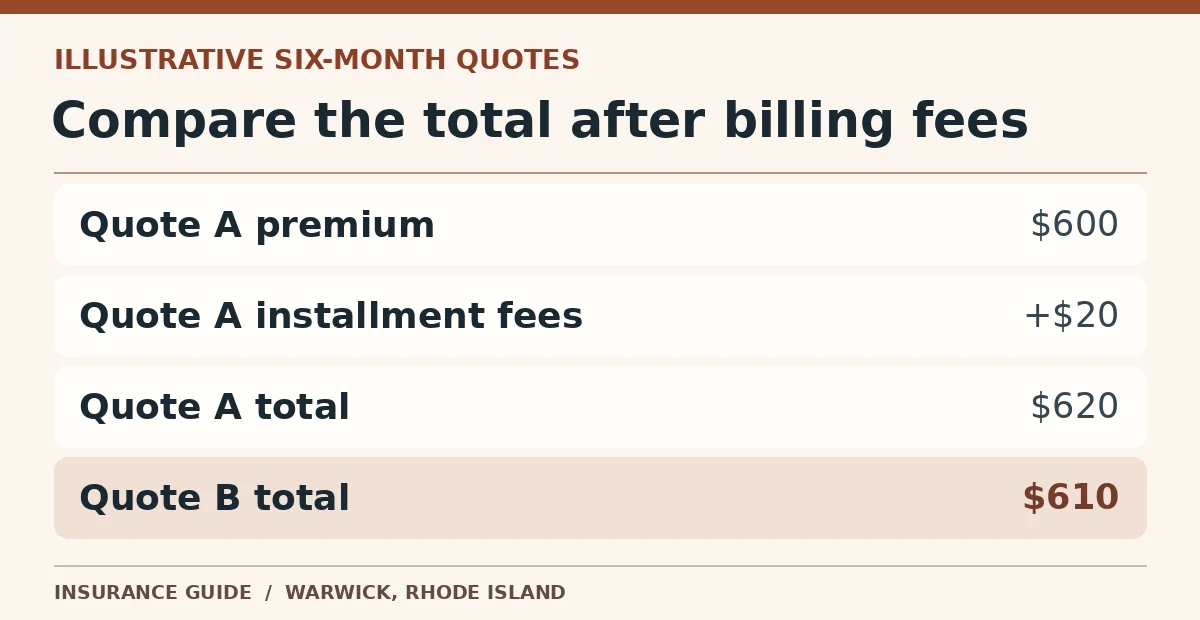
Once two companies have priced matching limits, ask for their pay-in-full and installment totals. One quote might show a $600 six-month premium with a $120 first payment and five more payments of $96. If the insurer charges a $4 fee on each of those five payments, the six-month cost becomes $620. A second company might offer the same coverage for $610 with no fees on the billing plan you want. Comparing the advertised premiums alone would rank those quotes in the opposite order from the cost you’d actually pay.
Record the dates that each price covers, whether the quote is still conditional on the insurer’s review, and how long the price is available. Keep a copy of the quote number and the list of selected coverages. If you ask an agent to rerun a quote, keep the first version until you’ve identified what changed. A lower second price can reflect a smaller liability limit, removal of a driver, or a higher deductible. These changes are easier to spot when you compare the line items on both versions.
Price changes one at a time
Start with a baseline that mirrors the coverage you want to keep. Then price one adjustment per request. For instance, ask what it costs to move from a $500 to a $1,000 collision deductible. That adds $500 to what you could pay on a qualifying collision loss where the deductible applies in full. If you learn that the change saves only $35 over six months, you can weigh the $35 savings against having to find an extra $500 after a crash. A separate request to remove rental reimbursement lets you see what that option costs on its own.
Use the same process for a discount tied to monitoring your driving. Ask what data the program uses, who needs to enroll, and how participation can affect pricing at renewal. Get the price without the program as well. A quote that shows only the enrollment price leaves you without a baseline if you decide you’d rather skip it. The Rhode Island Division of Insurance consumer resources include guidance on shopping for auto coverage.
Time the switch around the policy term
If you’re shopping at renewal, request quotes for the same day the old term ends and verify the start time with the new insurer. If you’re shopping midterm, ask the current carrier how it calculates any return premium, whether cancellation fees apply, and whether a change affects a separate policy in your household. Ask for those numbers before you decide when to move the policy. Have the new insurer confirm that coverage is active, then obtain written confirmation of the old policy’s cancellation date.
Compare the cost of keeping a bundle
An auto-only quote may change the price of your homeowners or renters policy if switching removes a multipolicy discount. Ask the current insurer for the household total after an auto switch and compare it with the household total if you move both policies. The site’s overview of Allstate bundle options in Warwick gives you a starting point for that conversation. Ask each company to itemize the actual discount on your quote.
Before switching, get the final premium, coverage selections, and effective date in writing. Save the insurance card and the cancellation confirmation together. The useful comparison is the amount your household pays for the coverage you selected, with the same drivers, limits, and deductibles on every quote.
Check the term total before choosing a Warwick car insurance quote
Give each insurer the same garaging ZIP, vehicles, drivers, mileage, and coverage. Compare the full price after installment fees and only then check whether bundling changes the total household cost. When an insurer offers a monitoring discount, compare the baseline with its usage-based car insurance quote.